A water softener removes calcium and magnesium, the minerals that make water hard. A water filter removes whatever it was built and certified to remove, such as chlorine, sediment or lead, and most filters leave hardness alone. So scale, spotty dishes and poor lather point to a softener. Odd taste, smell or grit point to a filter. A bad result on a water test goes to your health department first, and a softener does not make water safer to drink. This page sits in our water softener hub. It matches each problem to its fix, shows what each device leaves behind, works out the running cost, and gives the order to plumb them if you need both.
This is general information, not medical or professional advice. Take well test results and any illness to your state or county health department or a certified lab.
Match your problem to the fix
Find what you are seeing. Causes and fixes follow Penn State Extension’s symptom table unless another source is linked, and Penn State says a state-accredited lab test should confirm the cause and how severe it is.
| What you notice | Likely cause | What usually fixes it | Will a softener help? |
|---|---|---|---|
| White film on fixtures, scale in the kettle, poor suds | Hardness | Ion-exchange softener | Yes |
| Chlorine or swimming-pool smell on city water | Disinfectant added by the utility | A filter certified to NSF/ANSI 42, per EPA’s treatment guide | No |
| Cloudy, dirty or gritty water | Silt, clay or oxidized iron | Cartridge filter, or a multi-level media filter for severe cases | No. Mud and clay can clog the resin |
| Orange, brown or black stains | Iron or manganese | Softener for low levels, oxidizing filter for higher ones | Sometimes. Penn State’s iron guidance limits it to dissolved iron under 5 mg/L, pH above 6.7 and hardness of 3 to 20 gpg. Other sources and manuals differ, so check yours |
| Rotten-egg smell, hot and cold | Hydrogen sulfide or sulfate-reducing bacteria | Shock chlorination or an oxidizing filter. Carbon only for mild cases, under about 1 mg/L | No. The same page says a softener may cause it in rare cases |
| Rotten-egg smell, hot water only | The water heater’s magnesium anode rod | Replace the rod with another metal. Removing it may void the warranty | No, and no filter either |
| Blue-green stains, metallic taste, pinhole leaks | Corrosive water pulling copper, and possibly lead, from plumbing | Acid-neutralizing filter, or soda ash injection | No. Minnesota’s health department lists pipe corrosion among softened water’s drawbacks. A neutralizer may raise hardness, so check it again afterward |
| Nothing visible, but you are worried about safety | Unknown. Many contaminants have no taste or smell | A lab test first, then a certified device if one is needed | No |
What each one removes
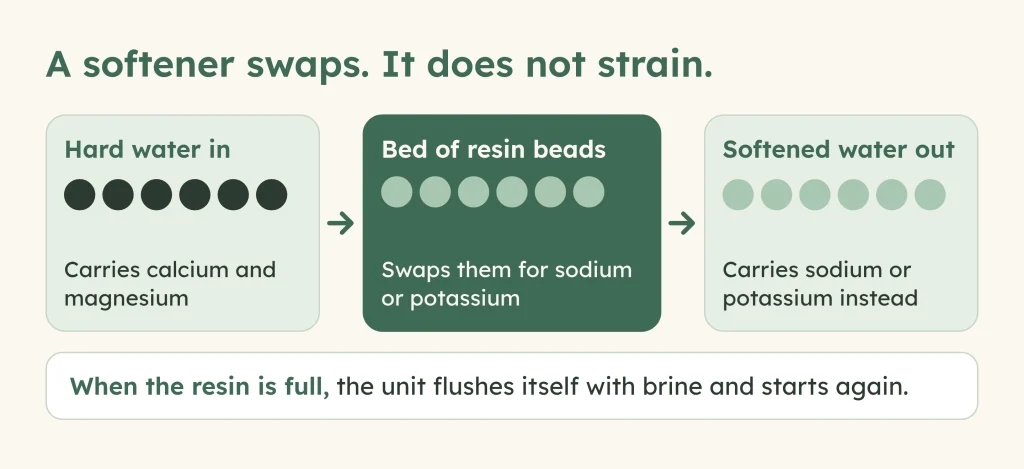
A softener is not really a filter. Water runs through a bed of resin beads, and the resin swaps calcium and magnesium for sodium or potassium. When the resin is full, the unit flushes itself with brine and starts again. Nothing is strained out, and the job is narrow: Penn State says softening “simply removes hardness minerals.” Nebraska Extension says it does not remove bacteria, hydrogen sulfide, silt or sand, lead, nitrate or pesticides.
“Water filter” is a family, not a product. A pitcher, a whole-house carbon tank and an under-sink reverse osmosis (RO) unit do different jobs, and EPA says no single system removes all contaminants. This table compares a softener with the two filter types most buyers weigh.
| Target | Softener | Activated carbon filter | Under-sink RO |
|---|---|---|---|
| Hardness | Yes, nearly all of it | No | Yes, at that one tap |
| Chlorine taste and odor | No | Yes | Yes, if the unit has a carbon stage |
| Lead | No | Only if certified for it | Yes, per CDC. Check the label |
| Nitrate | No | No | Some units. Nebraska Extension calls RO effective for nitrate |
| PFAS | No, per Minnesota sampling | Some, if certified to NSF/ANSI 53 | Some, if certified to NSF/ANSI 58. EPA’s PFAS filter sheet names both standards |
| Bacteria | No | No, and idle carbon can grow bacteria | CDC lists RO for bacteria, but a positive well test needs fixing at the source. See the test section |
| Sodium | Adds it (salt models) | No | Removes it |
| Uses extra water? | Yes, at each regeneration | No for cartridges. Backwashing tanks do | Yes. EPA estimates at least 5 gallons wasted per gallon made, or 2.3 or less for WaterSense models |
Two notes on that table. A softener’s reach goes a little beyond hardness: Minnesota’s health department says some may fully or partly remove copper, iron, manganese and radium, depending on the water, but none of that should be your reason for buying one without a test and a manufacturer’s claim. And RO is the real exception to “filters don’t soften.” EPA says it removes minerals such as calcium along with contaminants, but it treats one tap, so your shower and water heater still get hard water. We cover that choice in reverse osmosis vs a water softener.
When a softener is the right call
Buy for a measured number and a real nuisance. Hard water is a cost and comfort problem: EPA says it is not a health concern, and its secondary standards have no entry for hardness. Public sources put the line in slightly different places:
- EPA: install one only with “substantial hardness (e.g., above 180 mg/L or 10 grains per gallon)”, or where a local water authority or health and safety code recommends it. (180 mg/L is closer to 10.5 gpg.)
- Virginia Tech: treat only when hardness is causing a problem. Below 7 gpg (120 mg/L) generally needs no treatment.
- Connecticut DPH: its historic guideline recommended softening above 150 ppm, or 8.8 gpg.
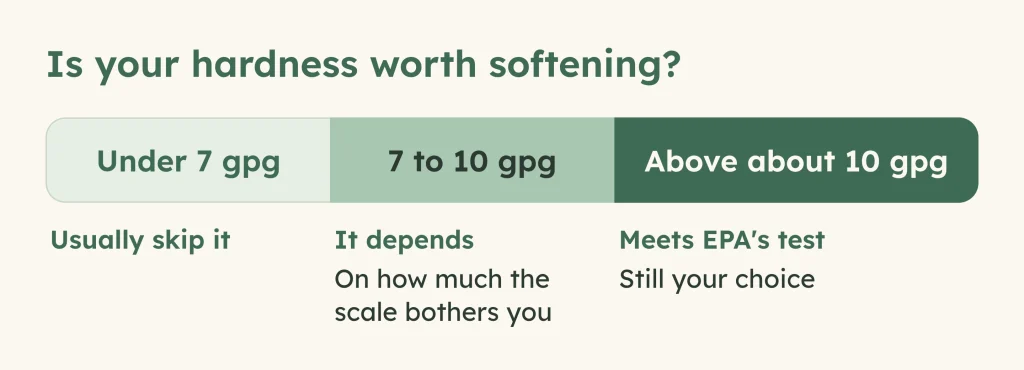
Read together: under 7 gpg, you can usually skip it. From 7 to 10 gpg, it depends on how much the scale bothers you. Above about 10 gpg, you meet EPA’s test, though it is still your choice. Our guide to whether you need a softener walks through that decision. To turn a mg/L result into grains per gallon, divide by 17.1, the factor Connecticut’s sheet uses.
Salt-free “conditioners” are a separate product. EPA’s guide describes them as neutralizing the water’s scale-forming properties and lists a different standard, IAPMO/ANSI Z601, a scale reduction standard. Read what salt-free units do and don’t do before treating one as a softener.
When a filter is the right call
Start small, at the tap. EPA’s guide says many household uses, such as flushing toilets and washing clothes, need no extra treatment, and that whole-house systems suit water with consistent, significant problems. It also says to avoid oversizing. Its cheapest fix for a chlorine taste costs nothing: pour water into an open pitcher and leave it in the refrigerator for a day or two.
A whole-house filter makes sense when the problem reaches beyond the kitchen, such as sediment, or sulfur smell in the shower. It is the wrong tool for lead. EPA’s lead filter guide leaves out whole-house units because they don’t remove lead coming from plumbing inside the building. It tells you to look for point-of-use filters certified to NSF/ANSI 53 for lead reduction and NSF/ANSI 42 for Class 1 particulate reduction.
Certification is claim by claim. “NSF certified” on a box tells you little until you know which contaminant and which standard, so ask for the performance data sheet, as EPA suggests. PFAS needs extra care. As of August 2026, Pennsylvania DEP says the standards “do not yet indicate that a filter will remove PFAS down to the levels” EPA set. Our PFAS water filter guide explains that gap.
Filters also need upkeep to keep working. North Dakota State gives three to six months of use for high-volume carbon filters, or sooner if flow drops or the problem returns. Nebraska Extension (2013) cites Rodale Press tests in which performance fell significantly after 75 percent of the maker’s stated lifetime, so changing cartridges early may be safer.
Safety worries: test before you buy
Neither device is the first step for a health concern. EPA says most harmful contaminants do not affect taste or smell, so good-tasting water proves little.
- City water: read your utility’s annual Consumer Confidence Report, which EPA’s guide says you should receive each summer. Call the utility for hardness if it isn’t listed, and ask about lead service lines.
- Private well: no utility is testing for you. CDC says to test at least once a year for total coliform bacteria, nitrates, total dissolved solids and pH. Add hardness and iron if you are shopping for equipment. Our well water test guide covers kits and labs.
- Bad result: call your state or county health department before you buy anything. EPA says nitrate can most severely affect pregnant women and bottle-fed babies. For bacteria, Penn State starts with shock chlorination of the well, then UV, chlorination or ozonation if it keeps coming back. A clean retest, not a new filter, shows the fix worked.
Use an independent lab even if a dealer offers a free test. Penn State says an independent test “is not expensive and will protect you from being oversold,” and its buying tips say to confirm home test results through one.
The sodium a softener adds
Salt-based softeners add about 8 mg/L of sodium for each grain per gallon of hardness removed, a figure Nebraska and North Dakota State both give. At 15 gpg, that is about 120 mg/L on top of what your water already holds. Two liters a day would add about 240 mg, or about 10% of FDA’s 2,300 mg Daily Value.
That is modest for most people, but not for everyone. EPA’s 2003 sodium advisory gives 20 mg/L as guidance for people limited to 500 mg of sodium a day, and says levels above 120 mg/L could be a problem for people on sodium-restricted diets if they stay high for a significant time. If you or someone at home has a history of high blood pressure, Minnesota’s health department says to consult a doctor about drinking softened water. Its two ways to cut the sodium are an unsoftened tap for drinking and cooking, or regenerating with potassium chloride. That swaps sodium for potassium: Connecticut’s fact sheet says about 76 ppm is added per 100 ppm of hardness removed. Virginia Tech suggests softening only the hot water, and under-sink RO also removes sodium.
What each costs to own
These are published ranges from public sources, not 2026 quotes. Local prices vary.
| Item | Published range | Source and date |
|---|---|---|
| Softener, hardware only | $500 to $1,500 | Penn State softening guide, updated September 2025 |
| Softener, retail | About $400 to $2,700 | North Dakota State, May 2022 |
| Whole-house carbon filter | $500 to $1,500 | Penn State buying tips, updated July 2026 |
| Point-of-use RO | $300 to $2,000 | Penn State buying tips |
| Faucet filter | $20 to $100, cartridges $10 to $30 every 2 to 6 months | EPA lead filter guide, February 2024 prices |
| Pitcher filter | $15 to $50, cartridges $5 to $20 every 2 to 6 months | EPA lead filter guide |
| Under-sink filter | $80 to $200 or more, plus a lead-free faucet, cartridges $50 to $100 every 6 to 24 months or more | EPA lead filter guide |
| Any whole-house system, installed | “Several thousand dollars” | EPA guide, November 2024 |
Hardware prices leave out installation, which EPA says may mean plumbing changes and professional maintenance, so get an installed quote. Cartridges decide what a tap filter really costs: at EPA’s figures, a faucet filter runs about $20 to $180 a year in replacements. We found no public source for whole-house cartridge prices, so look those up for the exact model before you buy.
Worked example, softener running cost. Take a family of four using 300 gallons a day, the figure in Connecticut’s fact sheet, with 15 gpg water.
- Hardness to remove: 15 × 300 = 4,500 grains a day.
- Salt: at the 3,350 grains per pound EPA’s fact sheet sets as its efficiency mark, 4,500 ÷ 3,350 = about 1.3 lb a day, or about 490 lb a year. A less efficient unit or a higher salt setting uses more.
- Bags: about 12 of the 40-pound size. At North Dakota State’s 2022 price of $5 to $10 a bag, that is about $60 to $120 a year. Potassium chloride ran up to $25 a bag.
- Water: at EPA’s efficiency mark of 4 gallons per 1,000 grains, about 18 gallons a day, or about 6,600 gallons a year. EPA says a typical softener uses 20 to 70 gallons per regeneration.
Run your own numbers in the softener ownership cost calculator.
Drains, septic and local rules
A softener needs a place to send brine, and that is where it differs most from a cartridge filter, which has no discharge at all. EPA’s guide says some local jurisdictions restrict softeners because of the salts they discharge, and tells buyers to check before purchasing. Rules vary by place, and two New England states show how:
- Connecticut: the health department’s 2023 fact sheet says softener backwash to a septic system is “specifically prohibited.” The technical standards in effect since 1 September 2026 say water treatment wastewater sent to a septic system “shall only be from a calcite filter, granular activated carbon filter, a Point of Use (POU) reverse osmosis unit or heavy-metal adsorption media.” Softeners are not on that list. Other routes, such as a holding tank, go through the local health department, and discharge to the ground surface, wetlands or open water is barred.
- Massachusetts: 310 CMR 15.004(8) says “Backwash of water purification or filtration devices shall not be discharged to an on-site system.” The rule never says “softener”, but a North Andover town guide applies it to softeners, and says backwash can go to a dry well approved by the local board of health. The rule’s wording also covers backwashing filters.
EPA’s tech sheet says too much sodium and chloride can harm septic systems or make it harder for a community to meet discharge limits. Connecticut lists overloading a marginal system and damage to concrete tanks among the risks, and Penn State says to consider the added load on your drainage field. We found no agreed figure for how much a well-run home softener affects a septic system, so we make no flat claim either way. If you are on septic, ask your local health department what it allows before you buy.
If you need both: the order
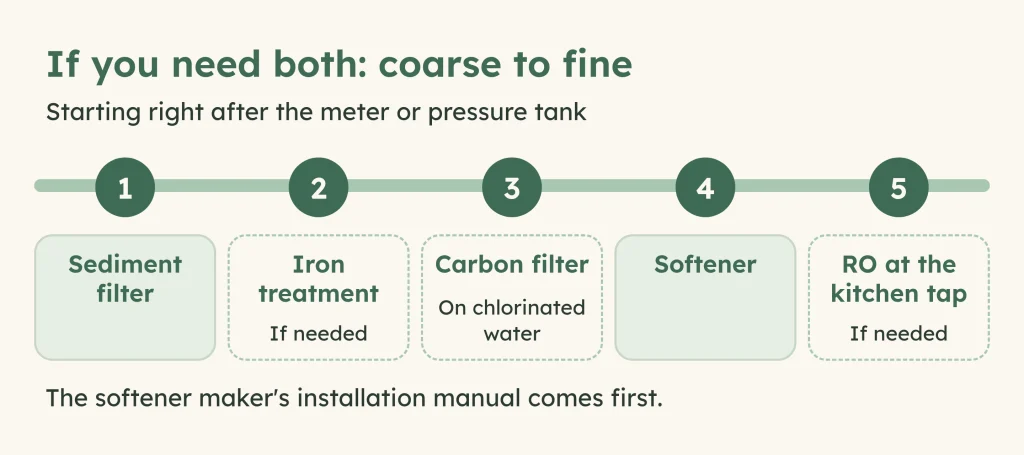
Hard water with a chlorine taste, or a well with sediment and scale, can call for both. The usual order runs from coarse to fine, but the softener maker’s installation manual comes first.
- Sediment filter. North Dakota State says it should be the first device on the line, right after the meter or pressure tank.
- Iron treatment, if needed. Penn State says oxidized iron will clog softener resin and should be removed by filtration.
- Carbon filter, on chlorinated water. This one is a judgment call. Dow’s resin manual (2011, reseller copy) recommends about 0.1 to 0.3 ppm free chlorine at most for standard gel resin in water from 40 to 70°F, and says more shortens resin life. That is a slow loss, not a sudden failure, and it is an industrial manual, not a rule for any home unit.
- Softener. Size it on your tested hardness and real water use, as EPA advises.
- RO at the kitchen tap, if needed. Nebraska says softening relatively hard water first can extend membrane life.
Some sellers offer a softener and carbon filter in one tank. Treat that as two claims. Ask for NSF/ANSI 44 certification for the softening and the matching standard for each filter claim, and confirm both on the performance data sheet.
What to do next
- Get real numbers: your utility’s report, or a certified lab test for a well, including hardness, iron and pH.
- Deal with any health result first, with your health department.
- If hardness is above about 10 gpg, or above 7 gpg and causing real trouble, price a softener.
- If taste or smell is the complaint, try the cheapest tap filter certified for that problem before anything whole-house.
- If you are on septic or in a place with brine limits, check local rules before you pay a deposit.
The Filtered Tap has no lab and tested none of these devices. This page compares published sources and certifications. Facts checked against primary sources on 2 November 2026. Every figure is checked against the linked source.
Sources
- Penn State Extension: Common Drinking Water Problems and Solutions (May 2025)
- EPA WaterSense: Guide to Selecting Water Treatment Systems (November 2024)
- EPA WaterSense: Soften Water Without Wasting It fact sheet (May 2026)
- EPA: Water Softeners tech sheet (July 2023)
- EPA: Choose the water filter that's right for you (lead)
- EPA: Drinking Water Advisory on Sodium (February 2003)
- eCFR: 40 CFR 143.3, secondary maximum contaminant levels
- CDC: About Choosing Home Water Filters (April 2024)
- CDC: Guidelines for Testing Well Water (July 2024)
- FDA: Daily Value on the Nutrition and Supplement Facts Labels
- Penn State Extension: Water Softening (September 2025)
- Penn State Extension: Tips for Buying Water Treatment Equipment (July 2026)
- Penn State Extension: Iron and Manganese in Private Water Systems (May 2025)
- Penn State Extension: Hydrogen Sulfide in Water Wells (December 2024)
- Nebraska Extension G1491: Water Softening (2014)
- Nebraska Extension G1489: Activated Carbon Filtration (2013)
- Nebraska Extension G1490: Reverse Osmosis (2014)
- NDSU Extension WQ1031: Water Softening, Ion Exchange (May 2022)
- NDSU Extension WQ1029: Filtration (February 2022), web page
- NDSU Extension WQ1029: Filtration (February 2022), PDF
- Virginia Tech Extension 442-664: Household Water Quality, Hardness (December 2024)
- Minnesota Department of Health: Home Water Softening (October 2022)
- Minnesota Department of Health: PFAS and home water treatment (April 2024)
- EPA: Reducing PFAS in Your Drinking Water with a Home Filter (April 2024)
- Connecticut DPH Publication 29: Hardwater-Softeners Facts and Issues (November 2023)
- Connecticut DPH: Technical Standards for Subsurface Sewage Disposal Systems (1 September 2026)
- 310 CMR 15.004, Massachusetts (Cornell LII copy)
- Pennsylvania DEP: Point-of-Use Devices Certified for Reduction of PFAS (August 2026)
- Dow: DOWEX Ion Exchange Resins Water Conditioning Manual (2011, reseller copy)
- Town of North Andover: Caring for Your Septic System, homeowner guide