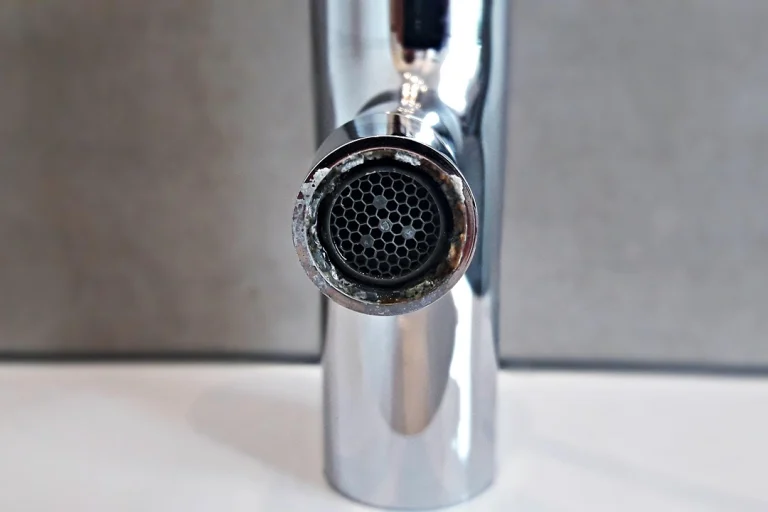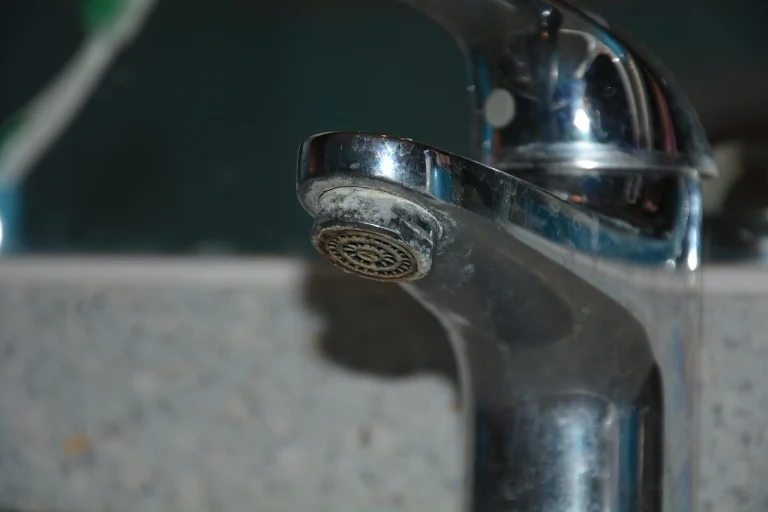
A water softener is usually worth it for comfort and cleaning once your water passes about 10 grains per gallon (gpg). It’s rarely worth it below 7 gpg. And it seldom pays for itself in money at any hardness, whatever the sales brochure says.
In our three worked examples below, soft water costs about $11 to $49 a month after the savings we could document. So the real question is whether soft water is worth that much to you. This guide shows the sum so you can run it with your own numbers. It’s part of our water softener guides.
- Likely worth it: hardness above 10 gpg, a tankless water heater, a house you plan to keep, and a household that’s tired of scale, soap film and spotty glasses.
- Probably not: hardness under 7 gpg, an electric water heater with little scale trouble, a move within a few years, or a sewer district or septic rule that limits softeners.
- Not a reason to buy: health, home value or a promised payback. The evidence for all three is thin.
What a softener really costs
There are two parts: the purchase, spread over the softener’s life, and the salt and water it uses every year.
Purchase. Penn State Extension puts the hardware at about $500 to $1,500 (updated September 2025), before installation. North Dakota State puts about $400 to $2,700 at retail (May 2022). Dealer systems run far higher. TapWaterData, a commercial site that collects customer-reported quotes, shows medians of $5,750 for Culligan and $5,500 for Kinetico, installed, from 10 and 11 quotes dated 2024 to 2026. Those come from forums, review sites and Better Business Bureau listings, and we found no primary source for dealer prices. It’s a small sample, and your local quote will differ. Our examples use $1,500 for a basic installed unit and $5,750 for a dealer system, to show both ends.
Lifespan. We found no government or university figure for how long a home softener lasts. Sellers often say 10 to 15 years. Warranties give a rough guide, though a warranty isn’t a promised life. One A.O. Smith model covers the tanks for 12 years, the control valve for 6 and the electronics for 3. Hellenbrand’s warranty gives home-size tanks 10 years and the valve 5. We assume 12 years, so a $1,500 softener costs $125 a year and a $5,750 one about $479.
Salt. Yearly salt in pounds is gallons softened a day × gpg × 365 ÷ the softener’s grains per pound of salt. EPA’s 2026 guide says efficient models exceed 3,350 grains per pound, so we use that. North Dakota State’s 2022 price is $5 to $10 for a 40-pound bag, and we use $10. Our softener salt guide has current shelf prices. Efficiency matters a lot here. At 15 gpg and 300 gallons a day, a unit managing only 2,000 grains per pound would burn about 820 pounds a year, against 490 at 3,350.
Water. Each regeneration flushes the softener to the drain. EPA’s guide says a typical unit uses 20 to 70 gallons per cycle. Its fact sheet says to look for 4 gallons or less per 1,000 grains removed, while the checklist in its guide says 5. We use 4. On city water you pay for that twice, once for water and once for sewer. EPA WaterSense estimates the 2024 national residential average at $16.83 per 1,000 gallons for water and wastewater combined, from American Water Works Association rate surveys. We use that. Local rates vary a lot, so use the per-gallon rate on your own bill if you can.
What it can save
The savings claims with real data behind them mostly trace back to one lab study. Battelle, a non-profit research organization, ran it for the Water Quality Association, the softener industry’s trade group, which supplied the heaters and approved the test protocol. The final report is worth reading, because the setup explains the numbers:
- Test water: well water at about 26 gpg, which is very hard on any scale. Battelle treats scale as rising in step with hardness.
- Heat: gas tanks ran near 160°F. By Battelle’s own rule of thumb, scale doubles with each 20°F, so that’s about four times the scale of a 120°F setting.
- Time: the tests ran for about 90 days and stood in for about one to two years of home use. The 15-year figures below are projections from that, not measurements.
Those choices are fair for a fast lab test, but they make the headline results lean high for a typical home. Battelle’s cost tables adjust for hardness, not for the high temperature. This table turns Battelle’s 15-year tables into a yearly figure. We’ve raised its $10 gas price to about $15 per million Btu, in line with EIA’s 2025 residential average of $15.34 per thousand cubic feet. Deliming stays at Battelle’s $120 a visit, a 2009 price that may be higher now.
| Hardness | Gas tank heater | Gas tankless heater | Electric tank heater |
|---|---|---|---|
| 10 gpg | About $19 a year | About $43 a year | $0 |
| 15 gpg | About $30 a year | About $58 a year | $0 |
| 25 gpg | About $56 a year | About $87 a year | $0 |
Electric tanks are $0 because their elements sit in the water, so efficiency held steady in the test. Battelle expects shorter element life on hard water, but it didn’t measure that.
A longer heater life. EPA’s guide says hard water can shorten the life of water heaters, washers and toilet parts. We found no independent figure for how many years. The Department of Energy puts the average storage heater at about 15 years. For scale, if hard water cost a $1,500 heater (a round number, not a quote) 3 of those years, softening would be worth about $25 a year.
Soap and detergent. The usual claim is that softened water cuts detergent use by half. It comes from lab studies funded by the same industry’s research foundation. The laundry summary says detergent “can be reduced by 50%”, from tests of soft water against water up to 30 gpg. The dishwasher summary reports savings of up to 70%, and an industry press release from 2011 put them at almost 30% against 10 gpg water and nearly 70% against 25 gpg. We read the summaries, not the full reports. Detergents and machines have changed since, and the foundation plans to repeat the studies for that reason. Check your receipts, then cut them by half at most. Our examples assume a family of four spends $200 a year and a couple $100 (illustrations, not survey figures), and that each saves the full half, which is generous at 8 gpg.
What we can’t price. Soft water has real gains that don’t fit a spreadsheet. Battelle’s showerheads and faucets on 26 gpg water clogged within days of accelerated testing, while those on softened water didn’t. Its washers and dishwashers on hard water showed visible scale after 30 days of heavy cycling. EPA’s guide also lists less soap scum and longer-lasting linens. Add less time scrubbing, and for many people this is the actual reason to buy.
Three worked examples
These are illustrations, not predictions. All three use the assumptions above: 3,350 grains per pound of salt, 4 gallons of water per 1,000 grains, $10 a bag, a 12-year life and, on city water, $16.83 per 1,000 gallons. Water use follows the Connecticut health department’s 300 gallons a day for a family of four, or 75 gallons a person. All of it is softened. Electricity, resin cleaner and repairs are left out, so the true cost runs higher. Household C also pays to pump its softener water, and that water still has to go somewhere, which matters on septic.
| Item | A: Couple, city water | B: Family of four, city water | C: Family of four, private well |
|---|---|---|---|
| Hardness | 8 gpg | 15 gpg | 25 gpg |
| Water heater | Electric tank | Gas tank | Gas tankless |
| Salt a year | 131 lb, $33 | 490 lb, $123 | 817 lb, $204 |
| Softener water a year | 1,752 gal, $29 | 6,570 gal, $111 | 10,950 gal, no water bill |
| Purchase, per year | $125 to $479 | $125 to $479 | $125 to $479 |
| Total cost a year | $187 to $541 | $359 to $713 | $329 to $683 |
| Heater savings | $0 | $30 | $87 |
| Soap and detergent savings | $50 | $100 | $100 |
| Net cost a year | $137 to $491 | $229 to $583 | $142 to $496 |
| Net cost a month | $11 to $41 | $19 to $49 | $12 to $41 |
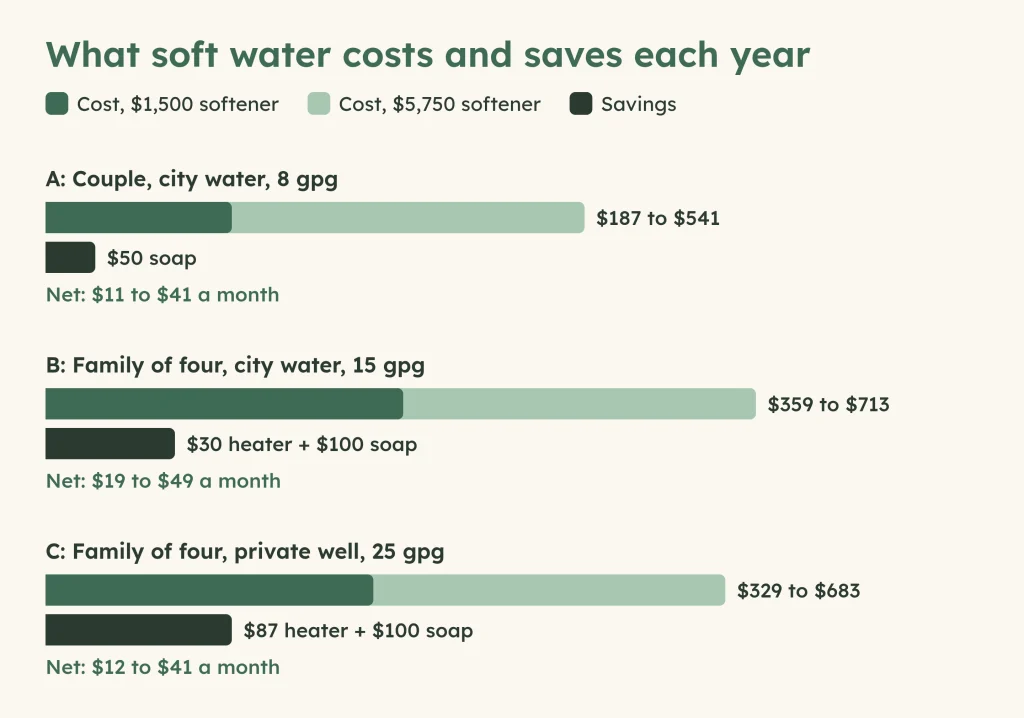
Three things stand out:
- The purchase price matters most. Choosing a $1,500 softener over a $5,750 one saves more each year than any other choice here.
- Harder water isn’t always a worse deal. Household C pays more for salt, but it has no water bill and it avoids repeat deliming.
- Household A gets the least for its money. It would pay for soft water at 8 gpg, where most of the trouble is mild. A better first step is a cheaper fix from the list below.
To run this with your own quote, use the softener cost calculator. It counts costs only, so subtract your own savings afterward, and its starting values are more cautious than ours (2,900 grains per pound, for one), so change them to fit. Your sum will shift with your quote and your scale problem, but in all three examples the softener costs more than it can be shown to save.
Seller claims, checked
| The claim | What we found |
|---|---|
| Hard water can cut appliance efficiency by up to 48% (Aquasana, crediting WQA) | Battelle measured gas tank heaters falling from 70.4% to 67.4% over about two years of equivalent use at 26 gpg, and tankless heaters from 80% to 72% before deliming. The figure matches the 2011 industry press release linked above, which says gas tank heaters on hard water face “as much as a 48% loss of efficiency” over 15 years. That’s a projection for one appliance, not a measurement. The nearest match in Battelle’s model is its extreme case: 30 gpg and 100 gallons of hot water a day for 10 years, 70.4% down to 36.4%. We can’t say whether Aquasana’s figure comes from there. |
| Hard water cuts appliance life by 30% to 50% | Aquasana also credits this to WQA. We didn’t find it in the Battelle report, and we couldn’t trace its source. |
| A softener pays for itself in 20 to 26 months (SoftPro, a softener seller) | That rests on about $1,560 a year in savings, some eight times the most we could document in our examples ($187). |
| A softener can pay for itself in a year | Battelle says cost recovery could come “in a period as short as a year” for tankless heaters if the water is hard enough, because of deliming visits. We can’t reproduce that from its tables. Its worst case, 30 gpg, adds $1,461 over 15 years at its $10 gas price, or about $97 a year. Either way, it doesn’t carry over to tank heaters. |
| A softener adds $5,000 to $10,000 to home value | Aquasana cites a real estate blog. We found no appraisal data that supports it. |
| Softened water is better for your skin | EPA’s guide says hard water can dry out skin and hair. But the best trial we found, of 336 children with moderate to severe eczema, found no added benefit over usual care. It says nothing about ordinary dry skin, and many people simply prefer the feel. |
When it is worth it
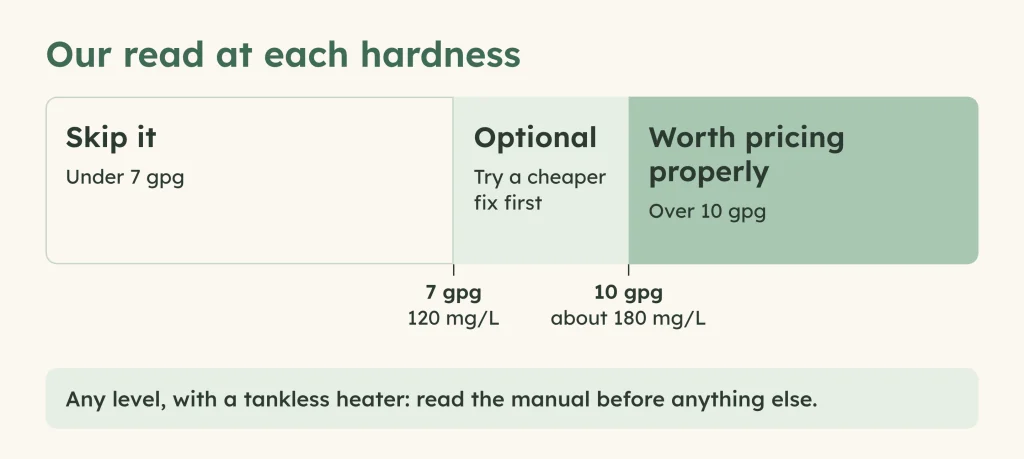
There’s no federal limit on hardness and no single cutoff. Connecticut’s health department notes there’s no standard for it. Penn State calls softening “a matter of personal preference not necessity.” These bands pull together the published guidance:
| Your hardness | Our read | Basis |
|---|---|---|
| Under 7 gpg (120 mg/L) | Skip it | Penn State: below 7 gpg probably won’t cause major scaling or soap film |
| 7 to 10 gpg | Optional. Try a cheaper fix first | EPA’s guide: above 120 mg/L “may benefit from softening”. Connecticut historically recommended softening above 8.8 gpg |
| Over 10 gpg (about 180 mg/L) | Worth pricing properly | EPA: softeners are “often recommended” at this level |
| Any level, with a tankless heater | Read the manual before anything else | See below |
Tankless heaters deserve their own check. A Rinnai C199i manual lists total hardness up to 200 mg/L (about 11.7 gpg) and says heat exchanger replacement for water quality damage isn’t covered. A Rinnai warranty for its Demand Duo heaters excludes failures from water quality and scale build-up. Other brands and models differ, so read your own. If your heater’s warranty depends on water below a set hardness, that may settle the question. Softening is one way to meet the limit. Regular deliming is the usual alternative, but check that the manual accepts it.
Soft water also earns more of its keep if you do a lot of laundry, have scale on glass and fixtures you’re tired of cleaning, or have a well, where softener water doesn’t add to a water bill.
When to skip it
- Local rules say no. EPA’s guide warns that some jurisdictions limit or prohibit softeners, so check before you buy. California, for one, lets certain local agencies restrict new units that discharge to a community sewer, after findings and a salinity study. We found no statewide ban.
- You’re on septic and haven’t checked. Connecticut’s health department says softener backwash to a septic system is “specifically prohibited”, and softeners aren’t on the approved list in its September 2026 standards. Rules vary a lot by state, and the evidence is disputed: the softener trade group says brine does no harm when softeners follow its guidelines, while Connecticut lists overloading and cement damage. EPA says to check with your septic maker or a local service provider first.
- You’re watching your sodium. North Dakota State says softening adds about 8 mg/L of sodium per gpg removed. At 15 gpg that’s about 120 mg/L, or 240 mg in two liters, about a tenth of the 2,300 mg Daily Value. EPA’s non-enforceable guidance level is 20 mg/L for people on a 500 mg a day diet. If you’re on a restricted diet, ask your doctor. Nebraska Extension says homes often avoid softened water for drinking and cooking with a separate cold line to the kitchen tap.
- Your real problem is something else. Nebraska Extension says softening doesn’t remove bacteria, lead, nitrate or pesticides, among other things. Hard water itself isn’t a health concern, according to EPA. On a well, start with a proper lab test, and take any worrying result to your county or state health department.
- You’re moving soon. Most of the purchase cost stays behind with the house, and Hellenbrand’s warranty ends if you sell the system or move it. Renting may suit you better, so price renting against buying before you sign.
Cheaper fixes to try first
- Lower the water heater setting. It’s free, and scale falls quickly with temperature on Battelle’s rule of thumb. Connecticut advises keeping hot water under 140°F. Check your heater’s manual first, since temperature also affects scalding and bacteria risk.
- Flush or delime what you have. Connecticut’s fact sheet says carbonate scale can be removed from heater elements and boiler tubes by treatment and flushing. Follow the manual.
- Change detergent. The same fact sheet suggests sequestering (polyphosphate) detergents rather than soap alone.
- Soften less water. If you do buy, EPA suggests softening only some uses, such as hot water, and leaving out outdoor lines. Toilets don’t need it either, as Connecticut points out. That cuts salt and water, though it can mean extra plumbing work.
- Look at a salt-free conditioner. EPA’s guide says these can reduce scale without added chemicals or water waste, and points to the IAPMO/ANSI Z601 standard. Its 2023 tech sheet is more cautious, saying evidence suggests some devices can. They don’t remove hardness, so don’t expect the soap and lather gains. Our salt-free softener guide covers what they can and can’t do, and our softener and conditioner comparison puts the two side by side.
How to decide
- Get a real hardness number. Use your utility’s water report, a hardness test or a lab. Penn State advises an independent lab before you buy, because free tests from sellers may oversell. If you aren’t sure yet, our guide to whether you need a softener covers the signs.
- Check the limits. Look up local softener rules, your septic system’s terms and your water heater’s manual.
- Get two quotes. Ask for one from a dealer and one for a store-bought unit with a plumber’s install. Ask each for the salt efficiency in grains per pound and the gallons per 1,000 grains.
- Do the sum. Take the total yearly cost, subtract only the savings you believe, and divide by 12.
- Ask yourself one question. Would you pay that amount each month for softer water? If yes, buy one that meets EPA’s marks: demand-initiated regeneration and NSF/ANSI 44 certification, sized for your hardness and water use. If no, stop there and use the cheaper fixes.
Facts checked against primary sources on 2 November 2026: EPA WaterSense, the Battelle report (read on a third-party copy), DOE, EIA, FDA, Connecticut DPH, Penn State, North Dakota State and Nebraska Extension, and manufacturer manuals. Dealer prices come from TapWaterData, a commercial site, and local quotes vary. The Filtered Tap has no lab, and every figure is checked against the linked source. This page is general information, not medical or professional advice.
Sources
- EPA WaterSense: Guide to Selecting and Maintaining a Water-Efficient Water Softener (May 2026)
- EPA WaterSense: Soften Water Without Wasting It fact sheet (May 2026)
- EPA WaterSense Homes: Water Softeners tech sheet (July 2023)
- Battelle: Study on Benefits of Removal of Water Hardness, final report for WQA (archived third-party copy)
- Water Quality Association: Softened Water Benefits Studies
- Water Online: industry press release on softened water studies (March 2011)
- Water Quality Research Foundation: Laundry Study Executive Summary
- Water Quality Research Foundation: Dishwasher Study Executive Summary
- WC&P International: WQRF plans to replicate the softened water studies (March 2026)
- Federal Register: DOE energy conservation standards for consumer water heaters (6 May 2024)
- EIA: Natural gas residential prices
- EPA WaterSense: Data and Information Used by WaterSense (national water and wastewater rates)
- Penn State Extension: Water Softening (September 2025)
- NDSU Extension: Water Softening, Ion Exchange (May 2022)
- Nebraska Extension G1491: Drinking Water Treatment, Water Softening
- Connecticut DPH Publication 29: Hard Water and Softeners (November 2023)
- Connecticut DPH: Technical Standards for Subsurface Sewage Disposal Systems (September 2026)
- California Health and Safety Code section 116786 (California Legislative Information)
- EPA: Drinking Water Advisory on sodium
- FDA: Sodium in Your Diet
- PLoS Medicine: Softened Water Eczema Trial (2011)
- A.O. Smith AOW-S400/S500 softener manual, warranty
- Hellenbrand E3 softener manual, warranty (third-party copy)
- Rinnai C199i manual, water quality table
- Rinnai Demand Duo R Series limited warranty
- TapWaterData: Softener brands compared (commercial site, read 2 November 2026)
- Water Quality Association: White Paper on Softener Brine Disposal to Septic Systems (industry source)
- Aquasana: Is a Water Softener Worth It? (seller claims reviewed)
- SoftPro: Water Softener ROI (seller claims reviewed)