A water softener removes calcium and magnesium from your water by swapping them for sodium or potassium. A salt-free water conditioner leaves those minerals in place and tries to stop them from forming scale. So softened water tests soft, and conditioned water still tests hard. If you want easy lather, fewer spots and a hardness reading near zero, buy a softener. If your main concern is scale in a water heater and salt is a problem, a salt-free unit can help, but the proof behind it is thinner. One warning before you compare prices: sellers also use “conditioner” for ordinary softeners, so check the hardware, not the label. This comparison is part of our water softeners hub.
This is general information, not medical or professional advice. The Filtered Tap has no lab. Everything here comes from published studies, standards and manuals, not from tests of our own.
The short version
- Softener: removes hardness. Needs salt, a drain and some water for each regeneration. Adds a little sodium.
- Salt-free conditioner: removes no hardness. Aims only at scale. No salt, no drain, but the media needs replacing and the feed water has to be fairly clean.
- Strongest result for conditioners: one template-assisted unit cut heater scale by more than 88% in a 21-day US study. A later university thesis found much smaller effects in a simplified test, and homes in a Canadian trial reported more film on dishes and glass.
- Electrical and electromagnetic devices: about 50% scale reduction in that same study, and Nebraska Extension still calls magnetic treatment unproven.
- Below about 7 grains per gallon: you may need neither.
“Conditioner” means three things
Most water softener vs water conditioner confusion starts here. We found no single legal or trade definition of the word, and even reliable sources use it in different ways.
- Any water treatment. Culligan says conditioning “refers to any kind of improvement made by a water treatment system”, which makes softening one type of it. California’s code speaks of a “residential water softening or conditioning appliance“.
- A salt-free scale device. This is what most people mean today, and what EPA means when it contrasts softening with “neutralizing the scale-forming water properties using a water conditioner“.
- An electronic or magnetic add-on. A box or coil on the pipe, usually sold as a conditioner or descaler.
So a quote for a “water conditioning system” may be a full salt-based softener. The hardware settles it.
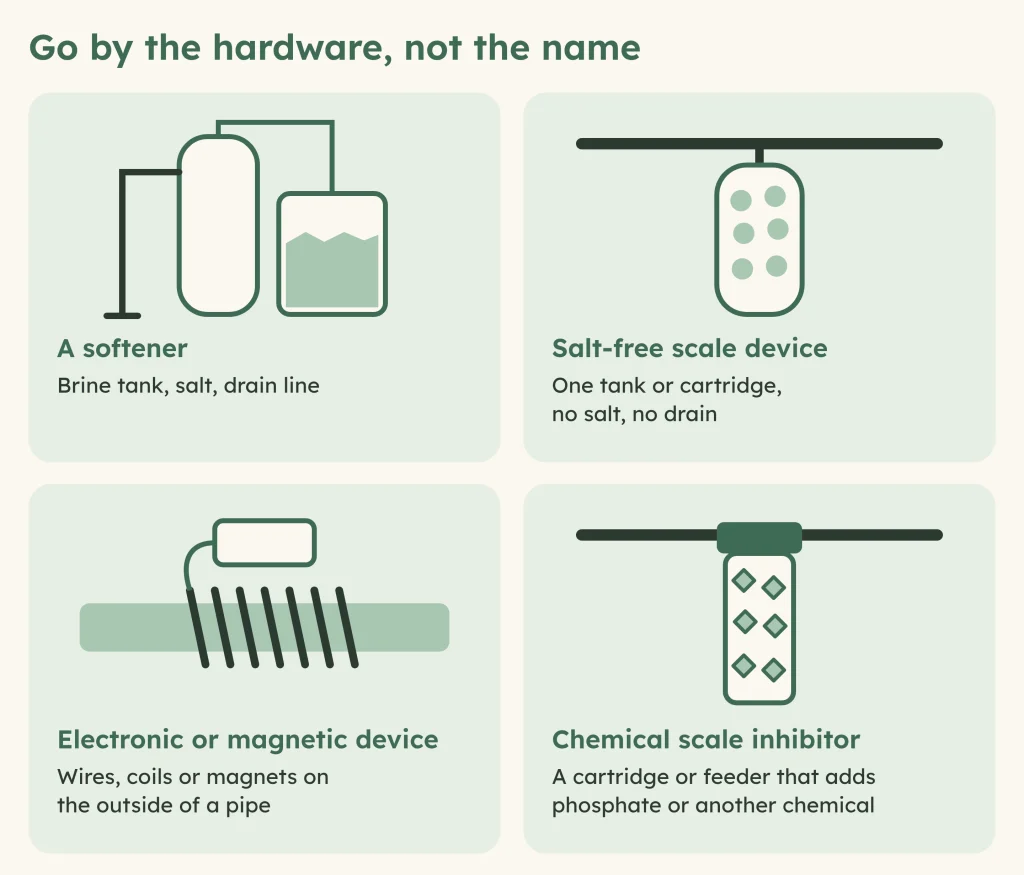
| What you see in the quote | What it is |
|---|---|
| Brine tank, salt, drain line, “ion exchange”, “regeneration” | A softener, whatever it is called |
| One tank or cartridge, no salt, no drain, “TAC” or “NAC” media | Salt-free scale device |
| Wires, coils or magnets on the outside of a pipe | Electronic or magnetic device |
| A cartridge or feeder that adds phosphate or another chemical | Chemical scale inhibitor, a separate category that the main US study did not test |
How each one works
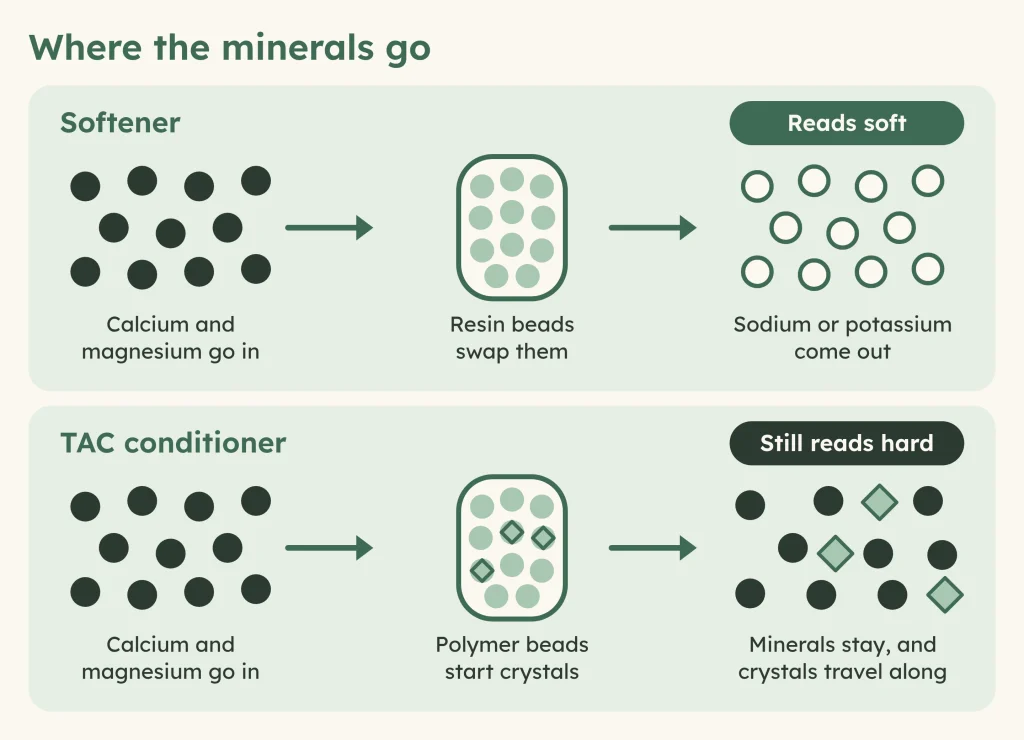
A softener holds resin beads loaded with sodium or potassium. As hard water passes through, the beads trade those ions for calcium and magnesium, which can remove nearly all of both. When the beads are full, brine flushes the hardness down the drain. That regeneration typically takes 20 to 70 gallons of water, EPA says.
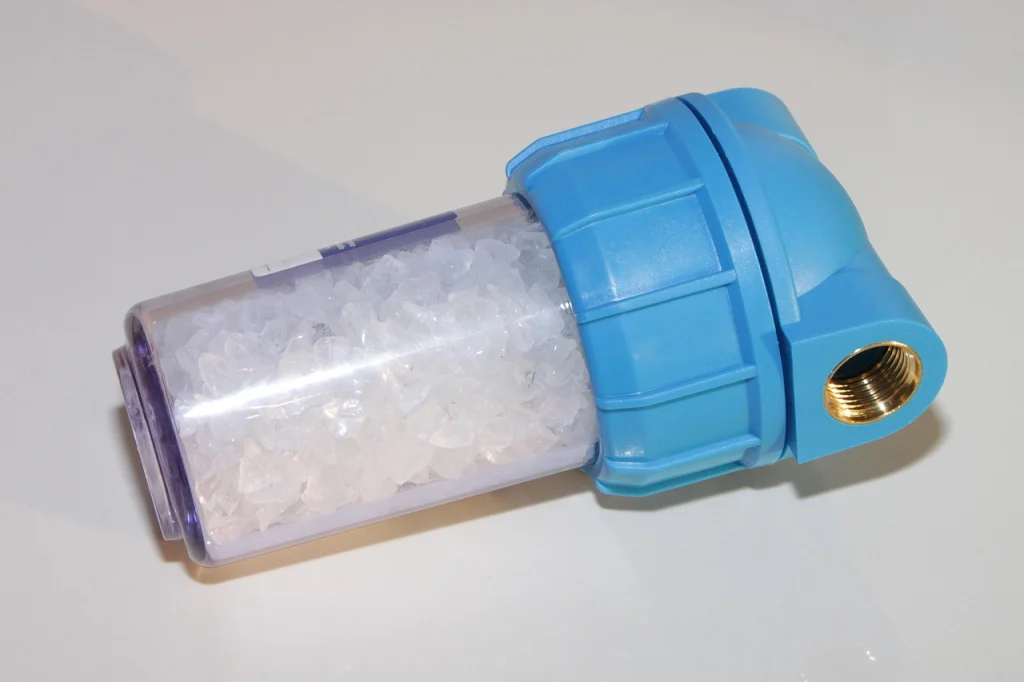
A template-assisted crystallization (TAC) unit holds polymer beads with tiny sites where calcium carbonate crystals start to grow. The crystals break off and travel with the water. In theory, hardness then builds on those floating crystals in a water heater instead of on the metal. Nebraska Extension’s plain label is the useful one: these are “descalant devices”, not hardness-removing devices. Nucleation-assisted crystallization (NAC) is the name you will see for the same family. Our guide to salt-free softeners goes deeper on the media and its limits.
What changes in your home
| Salt-based softener | TAC conditioner | |
|---|---|---|
| Calcium and magnesium | Removed | Stay in the water |
| Hardness test result | Reads soft | Still reads hard |
| Scale in water heaters | Strongly reduced | Reduced, by how much depends on the study |
| Spots and film on glass and showers | Reduced | Often remain, not measured in the main study |
| Soap and lather | Better | No independent study confirms a benefit, Nebraska Extension says |
| Sodium added | About 8 mg/L per grain of hardness removed with sodium salt, Nebraska Extension says | None |
| Salt and brine | Yes | No |
| Water used to run it | 20 to 70 gallons per regeneration | No backwash, per one maker |
| Main upkeep | Refilling salt | Media every 3 years or so, cartridges yearly, per one maker |
| Performance standard | NSF/ANSI 44 | IAPMO/ANSI Z601 |
What the evidence shows
The main US study was run by Arizona State University and HDR Engineering for the WateReuse Research Foundation, with public water agencies paying, and published in 2014. Each device treated 700 gallons over 21 days, based on the German DVGW W512 test, and the team measured the calcium scale left in a heated test rig against an untreated control. None of the listed funders is a manufacturer, though the agencies did want an alternative, because softener brine makes wastewater harder to reuse.
| Device | Scale reduction against no treatment | Waters tested |
|---|---|---|
| TAC | More than 88% | 3 waters, 4 tests |
| Ion exchange softener | 94% (our calculation from the report’s 0.06 ratio) | 1 water, 1 test |
| Electrically induced precipitation | About 50% | 3 waters, 4 tests |
| Electromagnetic | About 50% | 3 waters, 4 tests |
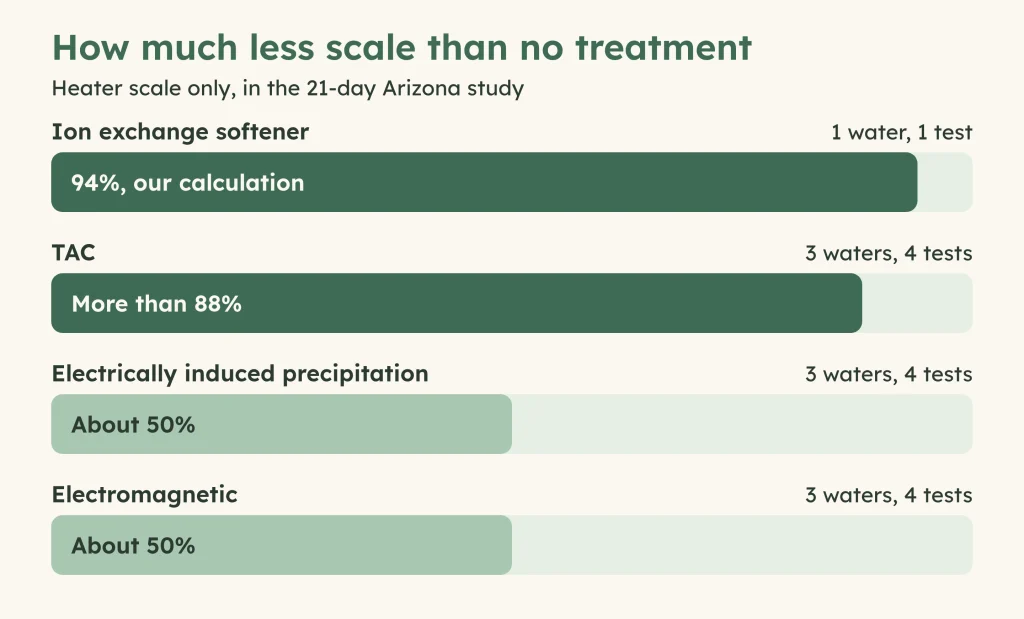
On the one water where both ran, TAC and the softener were close, with scale ratios of 0.04 and 0.06. That is a strong result for one TAC product, with four limits.
- It was short. Twenty-one days says nothing about media after three years.
- It measured only heater scale. The authors left out residue where water evaporates, saying they could find no credible test for it.
- TAC left the most scale on the hardest water. Scottsdale groundwater, at 450 to 500 mg/L (about 26 to 29 grains), left 3.2 g of calcium scale, against 0.33 to 0.65 g on the softer waters. Untreated water scaled far more there too, so the reduction was still 89% by the report’s ratio, and the authors said reduction did not depend on water type.
- A working unit gives no signal. The report says there is no way to tell whether such a device is working, other than watching for scale.
Other evidence cools the picture. A 2019 University of Waterloo thesis tested TAC on two source waters. Calcium and magnesium fell, but not by enough “to be of much practical value”, and a simplified scale test showed “relatively small differences” between treated and untreated water. The same thesis ranked TAC the most suitable household option in a separate multi-criteria assessment, and it suggested flow-through testing on new and used media. We read its abstract, not the full text.
Media life is a second open question. In a 2015 report for the Region of Waterloo, two TAC/NAC systems ran at high flow at a pumping station to simulate years of use. Performance was tracked by the drop in free calcium, not by scale itself. In the best runs, it stayed within the study’s limit of a 50% loss for the equivalent of about 4.4 to 4.5 years. In the first run, though, one unit declined within the equivalent of about a year, its media coated in manganese oxide, even though manganese was about 0.04 mg/L, under the maker’s 0.05 limit. The author notes that sitting just after a chlorination point may have sped this up, and that it isn’t clear the same would happen in homes. A faulty calcium electrode also clouded part of that run.
The only in-home trial we found is small but telling. Waterloo Region and Guelph put TAC or NAC units into volunteer homes that already had softeners, on water of 17 to 38 grains, for a year. The volunteers were screened for some concern for the environment, and they could keep the unit free. Of the 17 households that finished, 3 noticed little difference, 10 did more wiping and used more vinegar but kept the unit, and 4 asked for it to be removed, citing film on marble and glass and a dishwasher that no longer cleaned well. The study’s own summary says salt-free units are “not for everyone”. Nebraska Extension also notes that a fine dust may form on dishes, though it can be wiped away.
Electrical and electromagnetic units sit lower. The two in the Arizona study cut scale by about half and left a softer scale that brushed away. Nebraska’s December 2025 guide still treats magnetic treatment as “unproven technology without a strong scientific basis”, and North Dakota State cites the Water Quality Association on magnetic units’ “inconsistent performance”. We would not buy one expecting softener-like results.
Which certification counts
EPA’s November 2024 WaterSense guide, quoted above, gives one clear rule: choose a softener or conditioner certified to NSF/ANSI 44 or to IAPMO/ANSI Z601. Those are two different promises.
- NSF/ANSI 44 covers ion exchange softeners. EPA’s May 2026 softener sheet also suggests at most 4 gallons of water per 1,000 grains removed and more than 3,350 grains per pound of salt.
- IAPMO/ANSI Z601 covers scale reduction devices for home water heating. IAPMO’s own description of the 2018 edition requires at least 70% less scale in the heater and downstream piping. The current edition is Z601-2025. We could not read it, so we can’t say whether that figure changed.
- DVGW W512 is a German 20-day test at 80 °C, described in the Arizona report. It is a real test, but it is not a US certification.
Watch for the near misses. The same IAPMO article says two older criteria, IGC 91 and IGC 303, do not verify how well a device reduces scale. A product “listed” to one of those has shown something else, such as sound materials. Ask for the model’s certificate naming Z601, then confirm it in the certifier’s public directory.
Public sources don’t fully line up here. Virginia Tech wrote in December 2024 that no recognized US agency has set a protocol for physical water treatment devices, and Nebraska’s 2025 guide says consumers can’t yet be sure which products best reduce scale. EPA points to Z601 regardless, and its 2023 tech sheet says evidence suggests some devices can provide anti-scaling treatment. Our reading is that a Z601 certificate is the best proof on offer, and that it covers scale only. It tells you nothing about spots, soap or feel.
What each one costs
Softener hardware runs around $500 to $1,500 (Penn State, September 2025), or about $400 to $2,700 in North Dakota State’s wider 2022 range. We found no independent 2026 price survey for salt-free units. The dated figures we have don’t support the idea that they are always cheaper to buy: vendor quotes in the Arizona study ran $750 to $1,750 for TAC and $949 to $3,495 for softeners in 2012 dollars, and Water Softener Facts, the Waterloo and Guelph site, called purchase prices comparable at 2015 prices. Local quotes vary, so get your own.
Running costs are where the two split. A worked example with our own assumptions: three people, 75 gallons each a day, 15 grains of hardness, and a softener that just meets EPA’s suggested efficiency. A less efficient softener uses more salt and water than this.
- Hardness removed: 3 × 75 × 15 = 3,375 grains a day.
- Salt: at 3,350 grains per pound, about 1 lb a day, or roughly 370 lb a year. That is about 9 bags of 40 lb, or about $45 to $90 a year at North Dakota State’s 2022 price of $5 to $10 a bag. Prices may be higher now.
- Water: at 4 gallons per 1,000 grains, about 4,900 gallons a year.
- Salt-free tank: no salt or regeneration water. Watts’ FAQ specifies new media every three years for its tank systems and a new cartridge every year for housing systems. Ask for the price of that swap, and spread it across the years.
Be careful with the Arizona report’s average 10-year totals, $1,326 for TAC against $3,478 for softeners. Two of its three TAC quotes show $0 yearly upkeep, so they carry no media replacement, and it lists feed hardness of 150 grains per gallon, far above normal water and possibly a misprint. To price a softener with your own numbers, use our water softener cost calculator.
Which one fits your home
Start with a number. Get your hardness from your water utility’s report or a hardness test kit, and then find your row.
| Your situation | Start here | Why |
|---|---|---|
| Under about 7 gpg (120 mg/L) | Probably neither | Virginia Tech says levels this low generally need no treatment. EPA’s softener sheet suggests one only for substantial hardness, such as above 180 mg/L (10 gpg) |
| You want soft-feeling water, good lather and fewer spots | Softener | Only removing the minerals delivers these reliably |
| You only care about water heater scale | Softener on the hot line, or a Z601 unit | Virginia Tech suggests softening just the water to be heated, which also leaves cold taps unsoftened |
| Water of about 17 gpg and up | Softener, unless you accept more cleaning | Canadian homes at 17 to 38 gpg reported film with TAC, TAC’s weakest Arizona result, still 89%, came at 26 to 29 gpg, and a Watts manual recommends a 30-grain maximum because of residue. This 17 gpg cutoff is our judgment, not a standard |
| Well water with iron or manganese | Test first, then softener or pretreatment | See below |
| Local rules restrict softener discharge, or you have a septic limit | Salt-free unit, after checking the rule’s wording | No brine, but see below |
| Restricted-sodium diet | Ask your doctor, then consider potassium chloride, an unsoftened cold tap for drinking, or salt-free | At 15 gpg, softening adds about 120 mg/L of sodium, or about 240 mg in 2 liters, against FDA’s Daily Value of less than 2,300 mg |
Not sure you need anything? Our guide to whether your home needs a softener walks through that decision.
On a well, check iron first
This is the biggest practical limit on a conditioner. Watts’ FAQ warns that untreated well water may be a limitation, because hardness there often comes with other contaminants outside its operating guidelines. Its OneFlow OF220-2 manual sets maximums of 0.3 ppm iron, 0.05 ppm manganese and 1.3 ppm copper, under 2 ppm free chlorine, requires oil and hydrogen sulfide to be removed first, and rules out use with polyphosphate or any other scale inhibitor. Nebraska’s salt-free guide says salt-free options generally aren’t designed to remove iron and manganese.
Softeners tolerate more dissolved iron, but limits vary widely by maker, from 2 ppm to 11 ppm of clear-water iron, and Rheem’s manual says a softener won’t remove ferric or bacterial iron. Get a well water test before you choose either one, then see our guide to removing iron from well water. Take the results to a certified lab or your health department if anything looks wrong, not to a product seller.
If softeners are restricted where you live
EPA’s tech sheet notes that some jurisdictions limit softeners because of what they discharge. We found no statewide ban on softeners themselves, but the rules are local and they differ. Connecticut’s septic standards, effective 1 September 2026, authorize only listed treatment wastewater to reach a septic system, and softeners aren’t listed. The state health department’s 2023 sheet called that discharge “specifically prohibited”. By contrast, Texas allows demand-initiated units to drain to one, with conditions. A salt-free tank discharges no brine, which is the usual reason for these limits. Still, because California’s code says “softening or conditioning”, read your own local rule or ask the agency before assuming a salt-free unit falls outside it.
Neither one purifies water
Penn State warns that softeners “will not necessarily remove” the more serious contaminants. Nebraska Extension says softening doesn’t remove bacteria, lead, nitrate or pesticides, and its salt-free guide says those options don’t manage them either. Watts says its media alone removes neither chlorine nor fluoride. EPA says hard water itself is not a health concern, so if you are worried about what’s in your water, test it and take the results to your county or state health department or a certified lab.
Five questions for a seller
- Does this remove calcium and magnesium? What will a hardness test read after it? A softener seller can answer with a number. A salt-free seller should say it won’t change.
- Which standard is this exact model certified to? Ask for NSF/ANSI 44 or IAPMO/ANSI Z601 and the certifier’s name.
- What are the feed-water limits? Get hardness, iron, manganese, chlorine and copper in writing, and compare them with your test. Ask about residue as well as scale: the Watts OF220-2 manual says its media controls scale inside the plumbing at up to 75 grains, but recommends a 30-grain maximum because of soft scale residue outside the plumbing.
- When does the media need replacing, and what does that cost? Waterloo’s study participants said they had no way to tell when it was due. Watts says selected systems include a monitor that sends alerts, so ask whether this model has one.
- Is this accepted by my water heater’s warranty? Read the manual yourself. One Rinnai tankless manual lists a 200 mg/L hardness ceiling and says damage from water quality isn’t covered, and a Rinnai Demand Duo warranty excludes water quality and improper maintenance such as scale build-up. We found no maker’s statement that a conditioner satisfies those terms, so get the answer in writing. On a tankless heater, also ask whether the model’s Z601 certificate covers that use: a 2014 article on the draft said it did not, and a 2022 article on the IAPMO codes says it does.
Your next step is one number: find your hardness, in grains per gallon, before you talk to anyone selling either system.
Facts checked against primary sources on 2 November 2026. Every figure is checked against the linked source.
Sources
- WateReuse Research Foundation: Evaluation of Alternatives to Domestic Ion Exchange Water Softeners (2014)
- EPA WaterSense: Guide to Selecting Water Treatment Systems (November 2024)
- EPA WaterSense: Soften Water Without Wasting It (May 2026)
- EPA WaterSense: Water Softeners technical sheet (July 2023)
- Nebraska Extension G2275: Salt-Free Water 'Softener' Options (December 2025)
- Nebraska Extension G1491: Water Softening (Ion Exchange)
- Virginia Cooperative Extension 442-664: Hardness in Household Water (December 2024)
- Penn State Extension: Water Softening (September 2025)
- NDSU Extension WQ1031: Water Softening (Ion Exchange) (May 2022)
- Working Pressure: Scale Reduction Product Standards, by IAPMO's Tom Palkon (2019)
- WC&P: A New Standard for Evaluation of Scale Control Equipment, by NSF's Rick Andrew (October 2014, on the Z601 draft)
- Official: Water Treatment Standards and the IAPMO Codes, by Hugo Aguilar (November 2022)
- IAPMO: Current American National Standards
- Lin Shen, University of Waterloo thesis on template assisted crystallization (2019, abstract)
- Peter Fox: NAC/TAC Performance Study for the Region of Waterloo (2015)
- Metroline Research Group: Water Conditioner Study final report for Waterloo Region and Guelph (2019)
- Waterloo Region and Guelph: salt-free consumer study summary
- Water Softener Facts: How softeners work
- Watts: OneFlow FAQ
- Watts: OneFlow OF220-2 installation, operation and maintenance manual
- Rheem RHS42 softener manual
- Hellenbrand E3 softener manual (third-party copy)
- Rinnai RL75i manual, water quality (third-party copy)
- Rinnai Demand Duo R Series limited warranty
- California Health and Safety Code 116785 (California Legislative Information)
- Connecticut DPH: Technical Standards for Subsurface Sewage Disposal Systems (effective 1 September 2026)
- Connecticut DPH Publication 29: Hard water and softeners (November 2023)
- 30 Tex. Admin. Code 285.37
- FDA: Sodium in Your Diet
- Culligan: Water Conditioner vs. Water Softener (seller's usage of the term)