A water softener and a reverse osmosis (RO) system are not two versions of the same machine. A softener treats all the water entering your house and takes out the hardness minerals that cause scale. An under-sink RO system treats a few gallons a day at one tap and reduces many dissolved contaminants in what you drink and cook with. If your problem is scale, look at a softener. If your problem is something in your drinking water, look at RO. If you have both problems, you may need both, with the softener first. Test your water before you buy either. For the wider picture, see our guide to water softeners.
This is general information, not medical or professional advice. The Filtered Tap has no lab: this page compares published standards, specifications and agency guidance. Take well test results or health concerns to your state or county health department or a certified lab.
The short version
- Softener: whole house, removes hardness, protects plumbing and appliances. It is not a general safety treatment, and salt-based units add about 8 mg/L of sodium per grain of hardness removed.
- RO: one tap, reduces a wide range of dissolved substances. EPA says a typical unit sends five gallons or more down the drain per gallon of treated water, and a WaterSense-labeled unit no more than 2.3.
- Both: makes sense when you want softened water in the house and RO at the sink. RO makers’ manuals start calling for softened feed at about 10 grains per gallon (gpg).
- Neither: the answer for bacteria in a well, a rotten-egg smell, or plain chlorine taste. Each of those has a better first step, covered below.
Side by side
| Water softener | Under-sink RO | |
|---|---|---|
| Main job | Stop scale and improve lather | Reduce dissolved contaminants in drinking and cooking water |
| Where it goes | Where water enters the house | Usually under the kitchen sink, with its own faucet |
| How it works | Swaps calcium and magnesium for sodium or potassium on resin, then regenerates with brine | Pressure pushes water through a membrane; what stays behind goes to the drain |
| What it does to minerals | Replaces hardness minerals with sodium or potassium | Adds no sodium, and also removes minerals such as calcium |
| Standard to look for | NSF/ANSI 44 | NSF/ANSI 58, plus EPA’s WaterSense label |
| Routine upkeep | Keep salt in the tank, and clean the brine tank when it needs it | Prefilters about every six months, membrane every one to five years, per the maker’s schedule. EPA also says to drain the tank about every two weeks, and that many makers recommend sanitizing it once a year |
| Rules to check | Some jurisdictions restrict softeners | The two main model plumbing codes require NSF/ANSI 58 certification |
What each one removes
EPA says no single treatment system removes all contaminants, and not every RO unit handles every substance below. Buy for the specific contaminant, and confirm it on that model’s performance data sheet.
| Problem | Softener | Under-sink RO |
|---|---|---|
| Hardness | Yes. Can remove nearly all calcium and magnesium | At that tap only. Both minerals are on Nebraska Extension’s RO list |
| Sodium | Adds it (salt-based units) | Reduces it, per EPA’s treatment guide |
| Nitrate | No | Partly. Nebraska gives about 85% to 95%, so very high levels can stay high |
| Lead | No, per Nebraska’s softening guide | Yes, on models certified for it |
| Arsenic | Do not rely on it | Yes, on models certified for it, but check the form: one maker’s manual says its unit cannot effectively reduce trivalent arsenic |
| PFAS | Do not rely on it | EPA says RO can reduce PFAS. See the certification limit below |
| Bacteria and viruses | No | Do not treat it as disinfection. See below |
| Hydrogen sulfide (rotten-egg smell) | No | No. It passes through the membrane |
| Dissolved iron | Some, within the model’s rating, which varies. Nebraska and NDSU mention up to 5 to 10 ppm | Not a job for it. Watts limits feed iron to 0.2 ppm, and Pentair’s manual is stricter: under 0.1 ppm in its table, about 0.01 ppm in its footnote |
| Radium | Often. Illinois says softeners can often remove 90%, though the sentence before gives up to 70% for ion exchange, lime softening and RO alike. Retest the treated water | Yes, it is on Nebraska’s list. Illinois says up to 70% |
| Chlorine taste | Not its job | Yes, through the carbon stage, not the membrane |
Bacteria: the sources disagree. EPA’s WaterSense report lists bacteria and viruses among the things RO can reduce. Nebraska Extension says RO can remove microorganisms but is not recommended for that use, and Penn State’s buying guide says it “will not remove most organic pollutants or bacteria.” The manuals settle the practical question: Pentair and Watts both say not to use their units on water that is microbiologically unsafe or of unknown quality without adequate disinfection. Feed RO safe water. Do not use it to make unsafe water safe.
PFAS: certified is not the same as below EPA’s limit. EPA’s own May 2026 proposed rule, the latest statement we found as of 2 November 2026, says the NSF/ANSI standard “is not yet revised to assure” that certified home devices “will consistently reduce PFOA and PFOS levels to below the MCLs,” the federal limits. Our guide to PFAS filter listings goes through what the listings do and don’t show.
Why one can’t stand in for the other
RO won’t protect the house. The glass from an RO faucet is very soft, but the shower, water heater and dishwasher still get hard water. Whole-house RO exists, but EPA left it out of WaterSense because such systems waste much more water and are “typically not recommended for most treatment applications.” EPA says point-of-entry systems in general can cost thousands of dollars, but we found no reliable public figure for whole-house RO itself. Our whole-house RO page covers when it is even worth pricing.
A softener won’t clean the water. Softening “does not remove bacteria, hydrogen sulfide, silt or sand, lead, nitrate, pesticides” and much else, Nebraska Extension says. Penn State adds that softeners “will not necessarily remove any of the more serious drinking water contamination problems.” Minnesota warns that softening can corrode pipes, which can contribute to elevated lead and copper. It also says bacteria and fungi can grow on softener surfaces if water isn’t disinfected first.
A TDS meter tells you about RO, not softeners. A softener swaps minerals rather than removing dissolved solids. By Connecticut’s figures, taking out 100 ppm of hardness adds 46 ppm of sodium. If that hardness is calcium, about 40 ppm of calcium leaves, so total dissolved solids rise slightly (our arithmetic). A TDS meter therefore can’t tell you a softener is working. Use a hardness test for that. On RO water a TDS meter is useful, because a healthy membrane should cut the reading sharply. WaterSense requires at least 75% TDS reduction in its membrane test. Nebraska says to test periodically to confirm the membrane is intact.
Which one do you need?
| What you see or test | Start here |
|---|---|
| Scale, spots and poor lather; hardness is high; no contaminant concerns | Softener alone, if the hardness justifies it |
| Soft or moderately hard water, plus a contaminant in a test or utility report | RO alone, certified for that contaminant, or another certified treatment |
| Hard water and a drinking water contaminant | Softener plus RO |
| City water that tastes of chlorine, and nothing else | Probably neither. Try a carbon filter certified to NSF/ANSI 42 first. EPA says a tap filter or pitcher may be all you need |
| Coliform or E. coli in a well test | Neither. Call your state or county health department before you drink it or buy anything |
| Nitrate near or above EPA’s 10 mg/L (as nitrogen) limit for public systems | Health department first, especially with a baby at home. Above 10 mg/L, Minnesota says to use a safe alternative source, such as bottled water, until the problem is fixed. Do not boil the water, which concentrates nitrate. Even with treatment, Minnesota recommends that babies under six months not drink the treated water |
| Rotten-egg smell | Neither. Find the source and treat it separately |
| Rust stains on well water | Identify the iron type first. RO units aren’t built for it, and a softener handles only a limited amount of dissolved iron |
How hard is hard enough? There is no federal hardness limit. Penn State’s scale calls 7 to 10.5 gpg hard and above 10.5 very hard, and says levels below 7 gpg will probably not cause major scaling. Connecticut’s health department has historically recommended softening above 8.8 gpg. EPA says softeners are “not necessary in all homes” and should only be considered where hardness is substantial or an appliance maker, code or utility recommends it. EPA also says some hardness is generally not a health hazard, so this is mostly a question of plumbing, appliances and comfort.
Using both: order and hardness limits
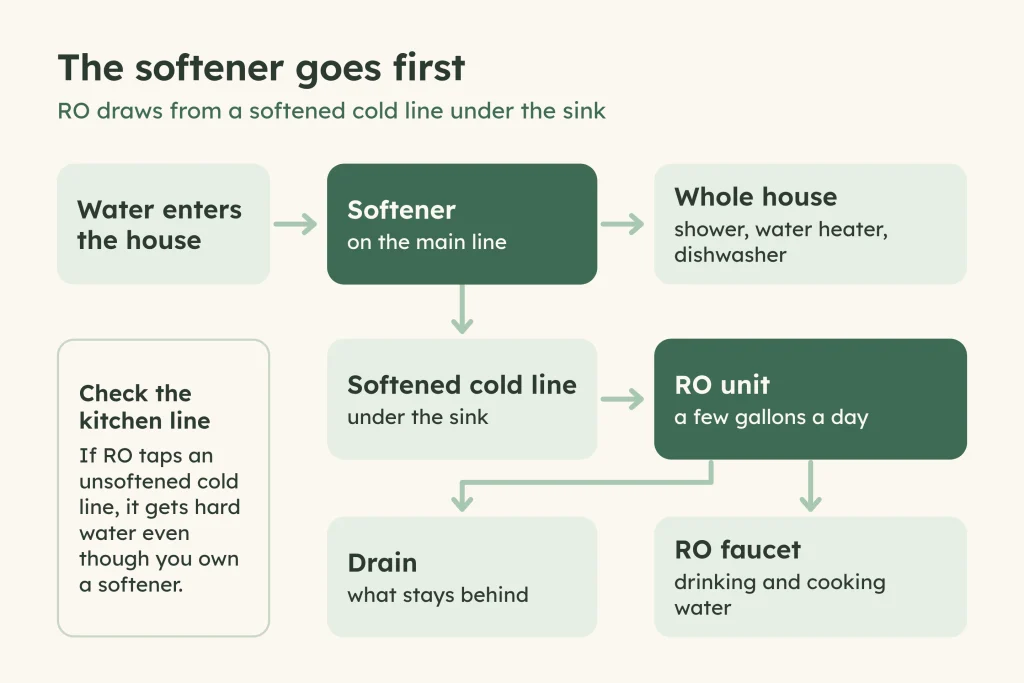
The softener goes first. It sits on the main line, and the RO unit draws from a softened cold line under the sink. The reverse order makes no sense, since RO makes only a small daily amount of water.
The number that matters is 10 gpg, and it comes from your manual. Three makers’ documents we read land on the same figure, with different force:
- Pentair RO-2550: maximum 10 gpg (171 mg/L). Above that, scale “will build up rapidly on the membrane.”
- Watts Premier: 10 gpg (170 ppm). The unit can run above that, but membrane life will be shortened, and a softener may lengthen it. The warranty conditions still say hardness should not exceed 10 gpg.
- GE GXRM10G: above 10 grains at pH 6.9, a softener is recommended, and skipping it “will reduce the life” of the membrane.
Your model may differ, so read its own manual. Nebraska Extension agrees in general terms that softening can extend membrane life on relatively hard water. We found no independent household study that measures how much longer membranes last, so treat any seller’s multiple as a claim.
So at 6 gpg, RO alone is within those manuals’ limits, and a softener is a separate decision about your house. At 18 gpg, plan on softening the RO feed or expect to replace membranes sooner. Watts says its unit can run there with shorter membrane life, but its warranty is void for defects that come from exceeding 10 gpg. Pentair doesn’t recommend it, and says running outside its specifications voids the warranty.
A few details are easy to miss when you combine them:
- Check the kitchen line. Some homes keep a cold line to the kitchen unsoftened for drinking, as Nebraska describes. If your RO unit taps that line, it is getting hard water even though you own a softener. Softening only the hot side, an option Penn State and Connecticut mention, has the same result.
- The softener carries the RO’s load. At EPA’s assumed 1,000 gallons of treated water a year, RO takes in about 3,300 to 6,700 gallons. At 15 gpg, that is about 50,000 to 100,000 extra grains a year, or roughly 5% to 9% more in our worked example below.
- Softening doesn’t replace the prefilters. Keep changing them. Nebraska notes that thin-film membranes deteriorate in chlorinated water.
- Check iron and pressure. Well water with iron may need separate treatment ahead of the RO. Watts sets a 40 psi minimum, and a softener or filter ahead of the unit can only lower what reaches it.
- Protect the plumbing after the RO. Nebraska says RO water can be more corrosive, so special plumbing goes in with the faucet. Watts warns against running it through copper tubing.
Sodium: how much, and what RO does
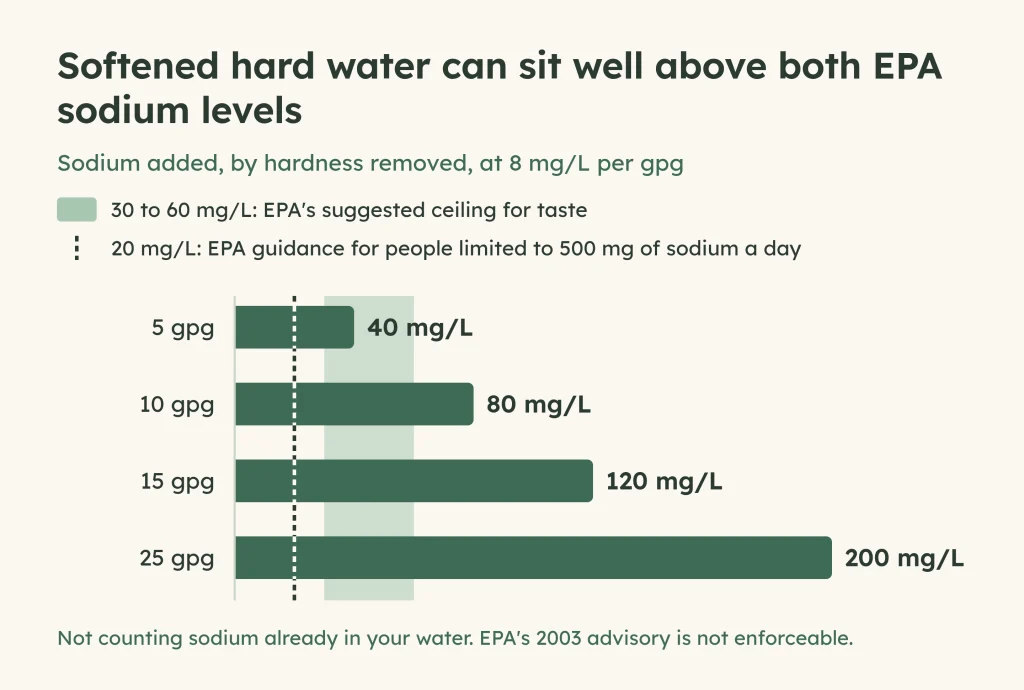
Agency and extension figures agree closely: about 8 mg/L per gpg removed (NDSU), and 46 ppm per 100 ppm removed (Connecticut). Using 8 mg/L, and not counting sodium already in your water:
| Hardness removed | Sodium added | In an 8 oz glass | In 2 liters |
|---|---|---|---|
| 5 gpg | 40 mg/L | 9 mg | 80 mg |
| 10 gpg | 80 mg/L | 19 mg | 160 mg |
| 15 gpg | 120 mg/L | 28 mg | 240 mg |
| 25 gpg | 200 mg/L | 47 mg | 400 mg |
Two benchmarks give those numbers context, and they point in different directions. The Dietary Guidelines figure FDA cites is less than 2,300 mg a day for adults, so 2 liters at 15 gpg is about a tenth of that. But EPA’s 2003 advisory, which is not enforceable, gives a guidance level of 20 mg/L for people limited to 500 mg of sodium a day, and recommends that sodium not exceed 30 to 60 mg/L, to protect taste. Softened hard water can sit well above both.
Minnesota’s advice is to ask a doctor if anyone at home has a history of high blood pressure. You have three ways to cut the sodium you drink:
- An unsoftened tap for drinking and cooking. Minnesota and NDSU both suggest it.
- RO on the softened line. EPA’s guide lists sodium among the things RO removes, and Illinois notes that RO adds none. We could not find a dependable household figure for how much gets through, so check the data sheet or test the treated water if the number matters to you.
- Potassium chloride in the softener. Connecticut says this adds 76 ppm of potassium per 100 ppm of hardness removed instead. NDSU says it uses about 10% more product and can cost up to $25 a bag. If you have been told to watch your potassium, ask your doctor first.
Costs and water use, worked through
Here are both sides on one assumed home: 15 gpg water and 200 softened gallons a day. That is an assumption, not an average. EPA’s figure is 82 gallons per person a day at home, and not all of that needs softening. The softener removes about 3,000 grains a day, or about 1.1 million a year.
| Softener | Under-sink RO | |
|---|---|---|
| Purchase price | About $500 to $1,500, hardware only (Penn State, September 2025, with the same range in its July 2026 buying guide). $400 to $2,700 at retail (NDSU, 2022) | About $300 to $2,000 for point-of-use units, RO included (Penn State, July 2026). $450 and up for RO systems certified for PFOA and PFOS (Penn State, 2024). Neither figure says whether installation is included |
| Consumables | About 7 to 10 bags of salt a year, or $35 to $100 at NDSU’s 2022 price of $5 to $10 a 40-lb bag | $120 and up per replacement, about every 6 to 12 months for carbon blocks and 12 to 24 months for RO cartridges (Penn State, 2024). Your model’s schedule and your water will change this |
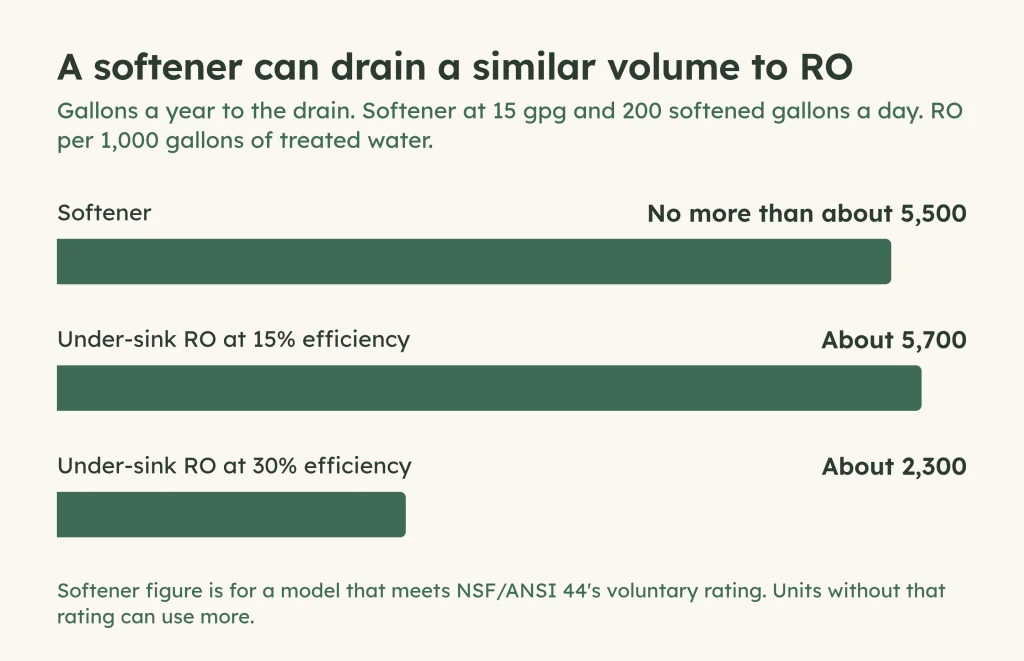
| Water to drain | No more than about 5,500 gallons a year, if the model meets NSF/ANSI 44’s voluntary rating. Units without that rating can use more | About 2,300 gallons a year at 30% efficiency, or 5,700 at 15%, per 1,000 gallons of treated water |
How we got these. The salt range uses 2,900 to 4,000 grains per pound, our calculation from ResinTech’s published resin capacities at 10 lb and 5 lb of salt per cubic foot. That is resin data from an older sheet, not a rating for any softener, and your unit’s setting will change the result. The softener water figure uses the 5.0 gallons per 1,000 grains in NSF/ANSI 44’s voluntary rating, as EPA reports it. Nebraska Extension’s older guide puts one regeneration at about 50 gallons. The RO figures are from EPA’s WaterSense statement, which assumes about 1,000 gallons of treated water a year and says typical units run at 10% to 20% efficiency.
RO looks like the wasteful one, but a softener in hard water can send a similar volume to the drain. And a WaterSense RO model cuts that waste: EPA estimates more than 3,100 gallons and nearly $50 a year against a typical unit.
Buying both adds up to about $800 to $3,500 on Penn State’s ranges, plus any installation not included. All of these are published ranges, not quotes, and local prices vary. Our softener price and running cost calculator runs the softener side with your own numbers. EPA says a well-maintained RO system can last 15 years, so count filter and membrane changes over that span, not just the purchase.
What to do next
- Find out what is in your water. On city water, read your utility’s annual water quality report. On a well, use a certified lab and our guide to well water testing. Penn State advises confirming a vendor’s alarming result with an independent lab.
- Measure hardness in gpg. That one number answers both the softener question and the RO feed question.
- Name the problem. Scale points to a softener. A named contaminant points to treatment certified for it. If you can’t name one, you may not need RO.
- Check local rules before buying a softener. EPA says some jurisdictions restrict them. On septic, rules differ by state. Connecticut’s 2026 standards list a point-of-use RO unit among approved water treatment discharges and do not list softeners, and the state’s 2023 softener fact sheet calls discharging softener backwash to a septic system “specifically prohibited.”
- Read the data sheet, not the box. EPA says makers must provide a performance data sheet. Check that your contaminant is on it, along with the daily production rate, the efficiency rating and the feed limits for hardness, iron and pressure.
- Test again after installation. Check softened water for hardness and RO water for your contaminant, and keep doing it on a schedule.
Facts checked against primary sources on 2 November 2026. Every figure is checked against the linked source.
Sources
- EPA WaterSense: Treating Water With Less Waste, Reverse Osmosis Systems (Nov 2024)
- EPA WaterSense: Specification for Point-of-Use Reverse Osmosis Systems, Version 1.0 (Nov 2024)
- EPA WaterSense: RO specification supporting statement (Nov 2024)
- EPA WaterSense: Guide to Selecting Water Treatment Systems (Nov 2024)
- EPA WaterSense: water softeners tech sheet
- EPA WaterSense: statistics and facts
- EPA: Drinking Water Advisory on Sodium (Feb 2003)
- eCFR: 40 CFR 141.62, inorganic contaminant limits
- eCFR: 40 CFR 143.3, secondary levels
- Federal Register 91 FR 29425: PFOA and PFOS compliance deadline proposal (20 May 2026)
- FDA: Sodium in Your Diet
- Nebraska Extension G1490: Drinking Water Treatment, Reverse Osmosis (rev. 2014)
- Nebraska Extension G1491: Water Softening (rev. 2014)
- Nebraska Extension G1784: Drinking Water, Nitrate-Nitrogen
- NDSU Extension WQ1031: Water Softening (rev. May 2022)
- Penn State Extension: Water Softening (Sept 2025)
- Penn State Extension: Tips for Buying Water Treatment Equipment (July 2026)
- Penn State Extension: Home Water Treatment for PFAS (June 2024)
- Minnesota Department of Health: Home Water Softening FAQ
- Minnesota Department of Health: Nitrate in Drinking Water
- Connecticut DPH Publication 29: Hard Water and Softeners (Nov 2023)
- Connecticut DPH: Technical Standards for Subsurface Sewage Disposal Systems (Sept 2026)
- Illinois Department of Public Health: Radium in Groundwater
- Pentair RO-2550 installation and operation manual
- Watts Premier RO-TFM manual (2017)
- GE GXRM10G installation instructions, ManualsLib copy
- ResinTech cation resin specifications, distributor copy (2012)