Installing a water softener usually costs about $150 to $800 on top of the softener when the job is simple, going by published 2026 estimates, though nine real quotes gathered by one site had a median of $1,000. Softener and basic installation together come to about $1,100 to $1,400 on Homewyse’s May 2026 estimate and $800 to $2,500 on FixupFirst’s. A home with no softener loop, a far-off drain or no nearby outlet costs more, and a permit came to about $60 to $88 in the three 2026 fee schedules we read. We found no government survey of these prices, so every figure here is an estimate or a small sample, and we say which. This page is part of our costs and tools hub. It breaks a plumber’s bill into hours, rate, parts and permit, so you can check a quote line by line.
This is general information, not professional, legal or financial advice. Local quotes and rules vary, so confirm them with a licensed installer and your building department before you sign or start work.
The short version
- Labor on a home with a loop: TapWaterData models 2 to 4 hours at $153 to $429. PlumberCalc lists 3 to 5 hours at $200 to $700.
- Labor when the plumber cuts into the main: about 4 to 6 hours, or $306 to $644 on the same model (our addition of its figures).
- Real quotes run higher than the models. The median of nine installation-only quotes that TapWaterData collected from forums was $1,000.
- Hourly pay is not your hourly bill. The median plumber earns $30.67 an hour, but a company bills well above that, because the rate also covers its costs.
- Permits depend on your city. Three 2026 fee schedules we read work out at about $60 to $88.
- Get the scope in writing. Ask what the quote leaves out: drain run, outlet, bypass for outdoor taps, hauling the old unit and the permit.
What published estimates say
The main figures disagree because they measure different things, so read the “covers” column before comparing numbers.
| Source and date | Figure | Covers | Based on |
|---|---|---|---|
| Homewyse | $1,131 to $1,405 | Softener and basic installation, May 2026 estimate | A 20,000-grain unit, favorable site. Excludes permits, code upgrades, contractor markup and sales tax |
| TapWaterData | $153 to $429 | Labor only, home already has a loop | A model: 2 to 4 hours at $77 to $107 an hour, 4 Oct 2026. Hours and markup are its own assumptions. Discloses Amazon affiliate income |
| TapWaterData | $250 to $3,000, median $1,000 | Whole price to fit a softener the homeowner supplied | Nine forum-posted quotes, 2024 to 2026. Two of the nine jobs also included reverse osmosis |
| PlumberCalc | $200 to $700 | Labor only | 3 to 5 hours of plumbing tie-in. Headline labeled “2026 U.S. averages”. Cites no sources and shows no update date |
| FixupFirst | $800 to $2,500 installed; $300 to $800 labor | Softener plus installation; professional labor | Updated 18 May 2026. Its intro also says $200 to $500 for labor. Has a contractor quote form and affiliate links |
First, TapWaterData’s model sits far below the quotes it collected. It says the model leaves out parts and assumes an existing loop, while each quote is the whole price for a job. We read the model as a floor. Minimum charges and drive time also sit outside a simple hours-times-rate sum, and people may post on forums more often about jobs that surprised them. Nine forum posts are a warning, not a measure of typical prices.
Second, buying the softener from the installer changes the picture. TapWaterData counted a median of $3,450 across 20 forum quotes from independent installers and $6,500 across 43 reports on national dealer brands, with equipment included. Compare that with Penn State Extension’s general figure of $500 to $1,500 for whole-house units, updated July 2026, and $400 to $2,700 retail from North Dakota State University in 2022. Some of those quotes also cover filters or reverse osmosis, so the gap is not all installation labor. Ask for the lines separately.
How a plumber’s bill is built
A quote comes down to a simple sum:
Hours × billed rate + parts + permit + extras = installation cost
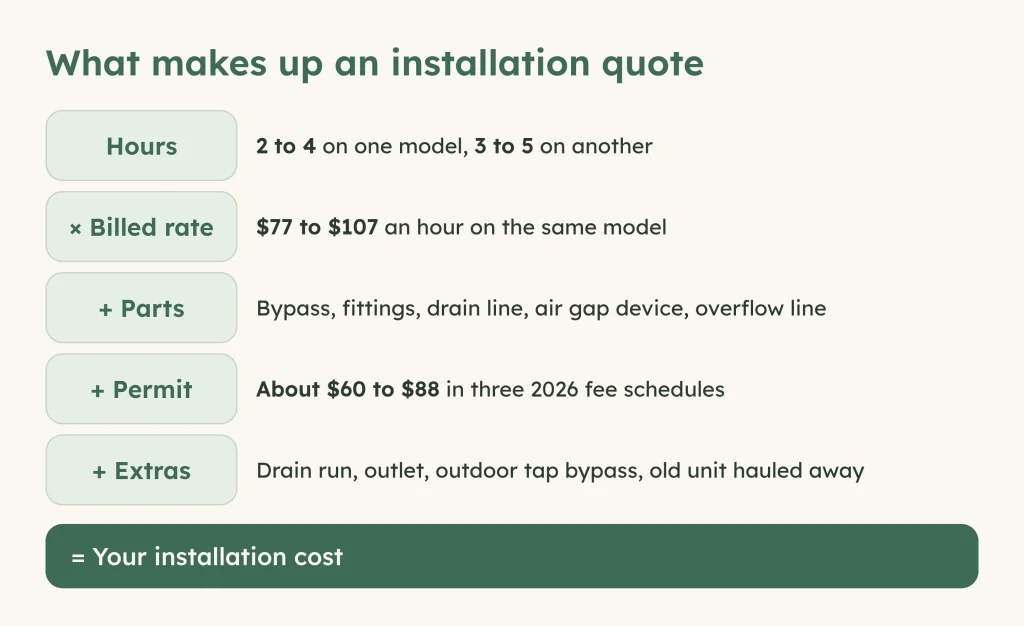
Hours. The 2 to 4 hour figure is a convention, not a measured average. TapWaterData says so itself, and PlumberCalc gives no basis for its 3 to 5 hours. Homewyse builds in a 2-hour minimum labor charge. Where a company sets a minimum like that, a very quick swap will not cost much less than a two-hour job.
Billed rate. We found no official figure for what plumbers bill. The best public number is what they earn. Bureau of Labor Statistics data for May 2025 show how much that varies:
| Area | Median plumber pay, per hour |
|---|---|
| Arkansas (lowest state) | $23.39 |
| Florida | $25.44 |
| Texas | $28.77 |
| United States | $30.67 |
| California | $35.01 |
| New York | $37.26 |
| Massachusetts | $45.14 |
| Illinois (highest state) | $48.05 |
| District of Columbia | $48.57 |
These are OEWS May 2025 estimates for plumbers, pipefitters and steamfitters, which we pulled from the BLS data service. They are wages, not prices. A bill also has to cover the van, insurance, licensing, office and profit. TapWaterData multiplies pay by 2.5 to 3.5 to allow for this, and says that multiplier has no outside source. Applied to the state medians above, as a rough guide only, it gives about $58 to $82 an hour in Arkansas and $120 to $168 in Illinois. The point is the spread: the same four-hour job can differ by hundreds of dollars between states.
Cost by type of job
Your home decides most of the labor bill. TapWaterData’s site classes are the clearest public breakdown. The totals below are our addition of its published dollar figures for the 2 to 4 hour base and the added hours, at about $77 to $107 an hour. They cover labor only and share the model’s weaknesses, so expect local quotes above them.
| Your home | Added hours | Modeled labor total |
|---|---|---|
| Softener loop already there | None | $153 to $429 |
| No loop: plumber cuts into the main near where it enters and adds the bypass and drain | 2 | $306 to $644 |
| No usable tie-in where the softener must go: new line run to it | 5 | $536 to $966 |
| Excavation needed to reach the line | 12 | $1,073 to $1,717 |
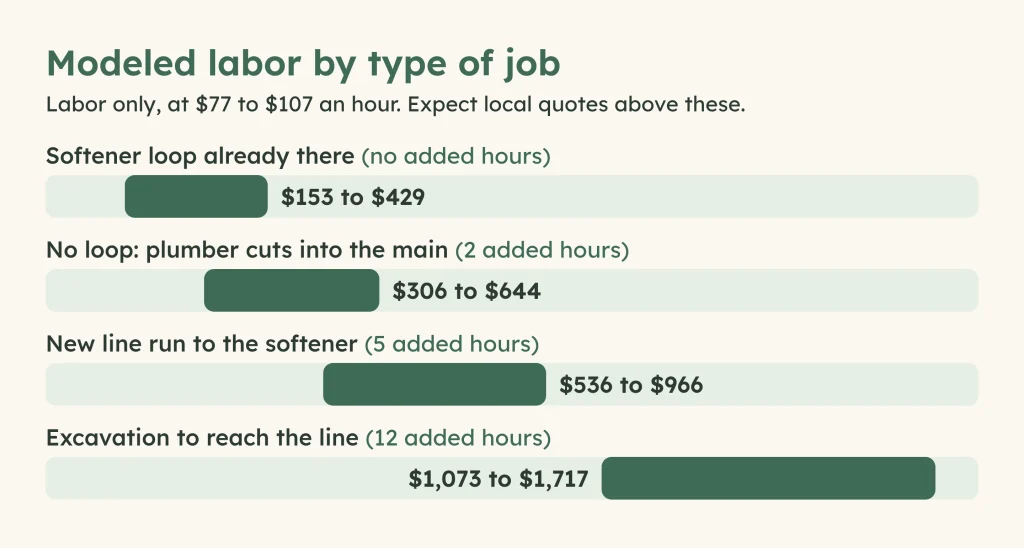
A softener loop is plumbing a builder leaves so a softener can be connected later, often two capped pipes or a short jumper in a garage or utility room. Ask a plumber whether yours has a drain and whether outdoor taps come off ahead of it. TapWaterData does not price replacements separately, but in our view a swap at the same spot belongs in the first row if the old connections are sound and meet current code.
Two worked budgets
These use published numbers only, with the national labor model and not local rates. They leave out fittings, tax, any labor to remove an old unit and any separate state fee. Swap on an existing loop in West Richland, Washington: modeled labor $153 to $429, plus the city’s $75 permit, plus Homewyse’s $28 to $32 for debris disposal, comes to $256 to $536 before the softener. Add Penn State’s $500 to $1,500 hardware figure and the total is $756 to $2,036.
New line in a South Bend, Indiana, home with no loop: modeled labor $536 to $966, plus the $60 minimum permit, plus $28 to $32 for debris disposal if there is an old unit, comes to $624 to $1,058. With hardware that is $1,124 to $2,558. Our water softener cost calculator lets you enter your own quote and adds salt and water over the years.
What the labor should cover
On an ordinary job, the plumber follows the softener’s manual. Rheem’s RHS42 manual is a good example of the steps. Homewyse’s basic labor line lists much the same scope: mounting, supply connection with shutoff, drain connection, power and water hookup, and checking that it works.
- Shut off the water and turn off the water heater’s power or fuel.
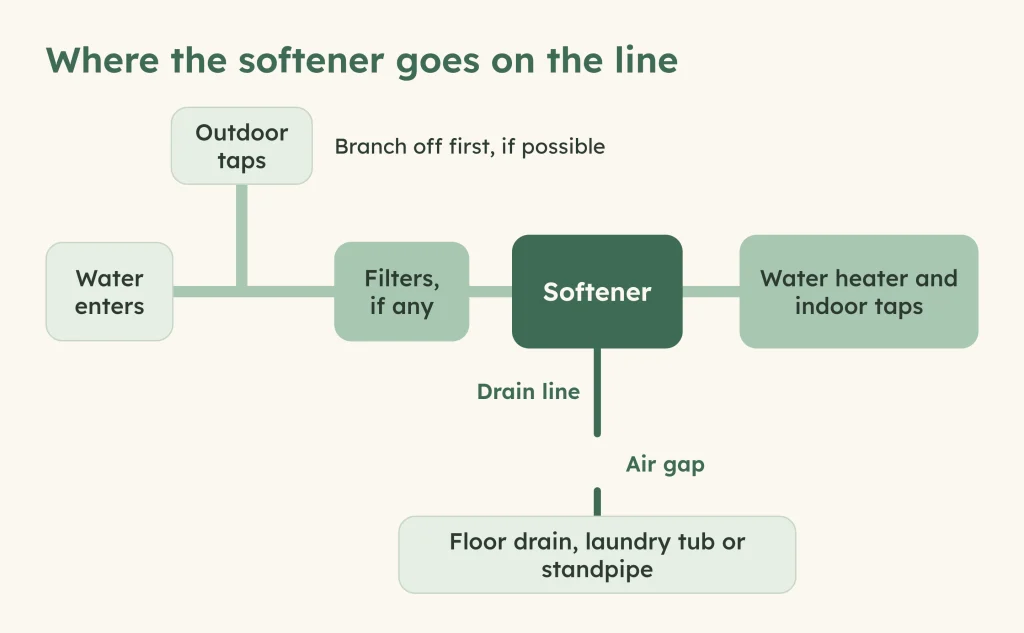
- Fit the bypass valve and connect the softener’s inlet and outlet, on the supply line before the water heater.
- Run the valve drain line to a floor drain, laundry tub or standpipe, leaving an air gap.
- Run the separate brine tank overflow line.
- Add salt and water, bring the unit up to pressure slowly and check for leaks.
- Set hardness and time, and sanitize the unit as the manual suggests.
Ask for two more things: a walk-through of the bypass valve and the settings, and a written note of the hardness number used. A softener set to the wrong hardness wastes salt or lets hard water through.
The add-ons that move the quote
Most of these have no reliable published price, so we give the requirement and leave the price to your quotes.
- Keeping outdoor taps on hard water. EPA’s May 2026 guide says to install the softener after the line branches to hose bibbs and irrigation if possible. Without a loop, this can mean extra pipe. PlumberCalc lists $150 to $600 for drain and loop work, with no source given. A Pleasanton, California handout (revised January 2020) goes further and requires untreated water at outdoor taps, with an exception for bypass valves on slab homes and where piping is physically inhibited.
- An unsoftened kitchen tap. NDSU mentions leaving one kitchen tap unsoftened to avoid the added sodium in drinking and cooking water. It means another pipe run, so price it as an option.
- A long drain run. Rheem’s manual says to avoid hose runs over 30 feet or raising the hose more than 8 feet above the floor. Some areas do not allow flexible hose, so a rigid line is needed.
- An outlet. The same manual calls for a grounded 120-volt outlet in a dry location. Adding one is usually electrician’s work, and in Lakeville, Minnesota, electrical permits are approved separately.
- A ground wire. Metal cold water pipes are often used to ground the house electrical system. Rheem warns that a plastic bypass valve at the unit breaks that path, and calls for a #4 copper jumper, parts not included, installed to local plumbing and electrical codes.
- Pressure parts. Rheem gives a 125 psi maximum and suggests a pressure-reducing valve if needed. It also says homes with a backflow preventer need an expansion tank under local codes.
- Filters ahead of the softener. EPA and Rheem both put other treatment before the softener. On a well, this can be a large line: iron, sediment or sulfur may need their own equipment. Penn State’s $500 to $1,500 range covers whole-house filters too.
- Cold garages. The softener cannot sit where it freezes, and the RHS42 is limited to 40 to 120°F. In a cold climate, the garage may be out, which can mean a longer pipe run.
- Removing the old unit. Homewyse lists debris disposal at about $28 to $32. It treats removing the old appliance as an optional extra line, so ask.
Permits and inspection
There is no national rule. Some cities require a permit even for a replacement, and only your building department can say what applies to you. Fees we read in 2026 schedules:
| Jurisdiction | Softener fee | Notes |
|---|---|---|
| St. Joseph County / South Bend, Indiana | $7 per softener | $60 minimum permit fee, so about $60 for a softener alone |
| West Richland, Washington | $75 | Residential plumbing flat fee, effective 1 Oct 2026. The schedule lists a $6.50 state building code fee separately |
| San Diego, California | $87.68 first unit, $52.39 each extra | May 2026 bulletin. Listed for a Simple Permit on houses, which needs no plan review. A $12.16 mapping fee applies only if plans are used |
The inspection can matter as much as the fee. Shorewood, Minnesota requires a plumbing permit for new or replacement softeners, a final inspection with an adult present, and a card posted during the work. Lakeville, Minnesota accepts photos for replacements in occupied homes, including the drain hose and air gap. Pleasanton, California, asks for a certificate from a licensed contractor at final inspection.
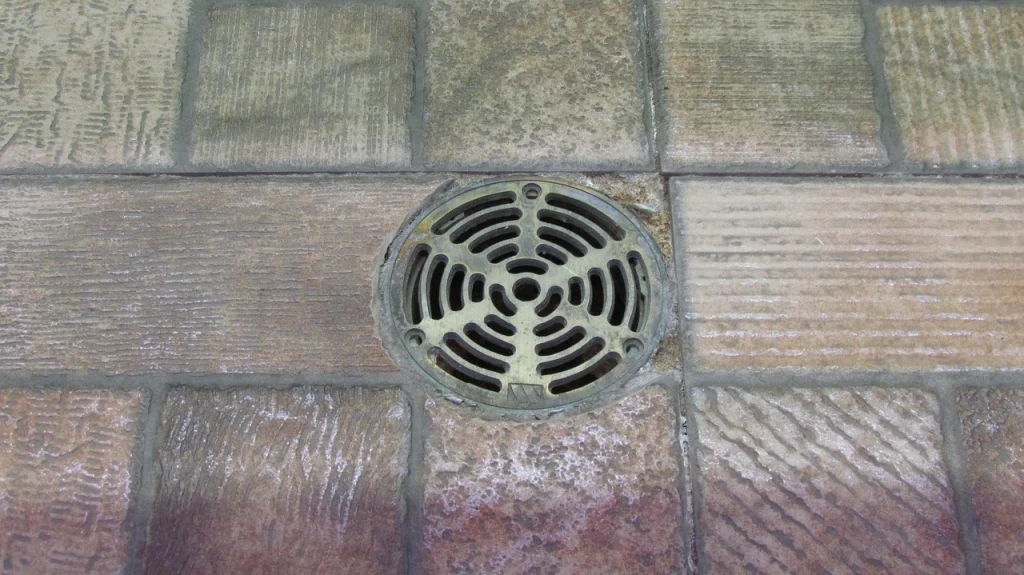
Inspectors look at the air gap, and the required size varies. Shorewood wants at least twice the tubing diameter and no less than 1½ inches. Rheem says 1½ inches. Pleasanton’s handout says at least 1 inch. Minnesota’s health department lists a softener line plumbed straight into a drain line, or into a floor drain or sink without an air gap, as a cross connection, and says some of these have contaminated drinking water. Minnesota’s plumbing rule requires an air gap or approved device for this discharge.
Call your building department and ask three things: Is a permit needed for this job? Is the fee flat or based on fixtures? Who pulls it, the homeowner or the contractor?
Who can legally do the work
A plumber is not your only option in some states, and in others an unlicensed handyman is not an option at all. Four examples, not a full list:
| State | Who may install for you | Your own home |
|---|---|---|
| Minnesota | Statute 326B.55: a licensed water conditioning contractor, with the work done by licensed plumbers or water conditioning masters or journeyworkers. We could not confirm whether a plumbing contractor’s license alone is enough, so ask the state | Owner-occupants need no license if the work meets state minimum standards, unless a local ordinance prohibits it |
| Texas | TCEQ: a Water Treatment Specialist license for work under contract. Licensed plumbers are exempt. TCEQ says private wells that do not meet the definition of a public water system fall outside these requirements, so ask what applies to a home on a private well | The page lists no homeowner rule. Ask TCEQ |
| California | CSLB has a C-55 water conditioning class. Pleasanton accepts C-55 or C-36 plumbing contractors | Check with your building department |
| Massachusetts | Rheem’s manual says a licensed plumber “shall be used” under 248 CMR | The manual gives no homeowner exception, and 248 CMR 3.05 says plumbing permits go to “properly licensed individuals only”. Confirm with your plumbing inspector |
Check any license on the state board’s site before you pay a deposit.
Doing it yourself
Where it is legal, doing it yourself saves the labor line. The softener’s manual walks through the steps. It makes the most sense when the loop, drain and outlet are all there.
It makes less sense when you need to cut into a main, work on a metal pipe that may be grounding the house, or get an inspection. A permit may still apply to you, and a drain with no air gap is a cross connection. Budget for fittings and tools, and read the warranty before you start.
Plumber, dealer or big-box store
- Independent plumber. You buy the softener and pay for labor, so the lines stay separate. Ask what the labor warranty covers if you supplied the equipment.
- Water treatment dealer. Sells, installs and services its own brand, and may offer rental. Quotes tend to be the highest in TapWaterData’s count, and may include service you do or do not want. If it offers rental, ask for the full cost over the years you expect to stay and compare that with buying.
- Home Depot and Lowe’s. We could not open either company’s service page, so we cannot confirm current scope, warranty or price. Get all three in writing, along with who does the work.
Be careful with a free in-home water test used as a sales visit. Penn State advises confirming a seller’s home test with an independent lab and getting second or third opinions. A hardness test kit or your utility’s report gives you the number first.
Septic systems and local limits
The drain line can raise a bigger question than cost. EPA says some local jurisdictions prohibit softeners and advises septic owners to check with the system’s maker or a local provider first. Rules differ widely:
- Connecticut: the 2026 Technical Standards list approved discharges to a septic system, and softeners are not on the list. Other routes, such as a dedicated dispersal system or holding tank, have their own standards, go through the local health department and add cost.
- Texas: softeners may drain to an on-site system if they meet 30 TAC §285.37, which requires demand-initiated regeneration, an installer label and an air gap. On a non-standard or proprietary treatment system, the softener’s drain must bypass the treatment unit. Softeners installed before 1 September 2003 must be brought up to these rules when the softener is replaced or the septic system is altered or repaired.
- Maine: state rules class the discharge as minor for single-family and duplex homes and allow alternatives to the septic system, subject to setbacks and conditions. A municipality may set its own requirement, so ask yours.
- California: we found no statewide ban, but certain local agencies may restrict new softeners that drain to a community sewer after making required findings. Pleasanton’s handout says softeners must discharge into the sanitary sewer, and it also lists demand control and a 4,000 grains-per-pound salt rating. The statute names only two routes, regeneration at a separate facility or discharge to a community sewer, and neither mentions septic. We could not confirm how that applies to homes on septic, so ask your local agency before you buy.
Before anything is plumbed, check these rules, because they can change the equipment and not just the bill. Where softeners that drain on site are restricted, ask about a portable exchange service, which regenerates tanks elsewhere. A salt-free unit is a different product and does not do the same job.
How to read a quote
Penn State advises getting multiple estimates and everything in writing. Ask each installer to separate these lines:
- Softener make, model, resin volume and salt efficiency, with NSF/ANSI 44 certification if claimed.
- Labor hours and rate, or a stated fixed price.
- Parts: bypass, fittings, drain line, air gap device, overflow line.
- Pipe work, including the bypass for outdoor taps and any kitchen tap.
- Electrical work and any ground wire.
- Permit, inspection, and who handles them.
- Removal of the old unit.
- Warranty on labor and on equipment, in writing, and what service visits cost after that.
Then check the softener itself. EPA advises demand-initiated regeneration and more than 3,350 grains of hardness removed per pound of salt, and says to install one only with substantial hardness, such as above 10 grains per gallon, or on local advice. It also warns against oversizing, so run our sizing calculator before accepting a seller’s number. If you are still unsure about the purchase, start with whether you need a softener at all.
Facts checked against primary sources on 2 November 2026. Cost figures are published estimates from the named sources, not The Filtered Tap quotes, and we did not survey installers. Every figure is checked against the linked source.
Sources
- Bureau of Labor Statistics: Plumbers, Pipefitters, and Steamfitters
- BLS: OEWS May 2025 state estimates
- EPA WaterSense: Guide to Selecting and Maintaining a Water-Efficient Water Softener (May 2026)
- EPA WaterSense: Water-Efficient Home Water Softeners fact sheet (May 2026)
- Penn State Extension: Tips for Buying Water Treatment Equipment
- NDSU Extension: Water Softening (Ion Exchange), WQ1031
- Rheem RHS42 water softener manual
- St. Joseph County / South Bend permit fee schedule 2026
- City of West Richland Master Fee Schedule
- City of San Diego Information Bulletin 103
- City of Shorewood, MN: Residential Water Softeners
- City of Lakeville, MN: replacement inspection process
- City of Pleasanton, CA: Water Softener Installation Requirements
- Minnesota Department of Health: Cross Connections and Water Softeners
- Minnesota Statutes 326B.55
- Minnesota Rules 4714.0611
- CSLB: C-55 Water Conditioning Contractor
- TCEQ: Water Treatment Specialist license
- 248 CMR 3.05: permits (Massachusetts plumbing code, LII copy)
- 30 TAC §285.37
- Connecticut DPH Technical Standards, September 2026
- Maine 10-144 CMR ch. 241 §11
- California H&SC §116786 (California Legislative Information)
- Homewyse: Cost to Install a Water Softener
- TapWaterData: Water softener installation cost
- TapWaterData: Water softener cost
- PlumberCalc: Water Softener Installation Cost
- FixupFirst: Water Softener Installation Cost